
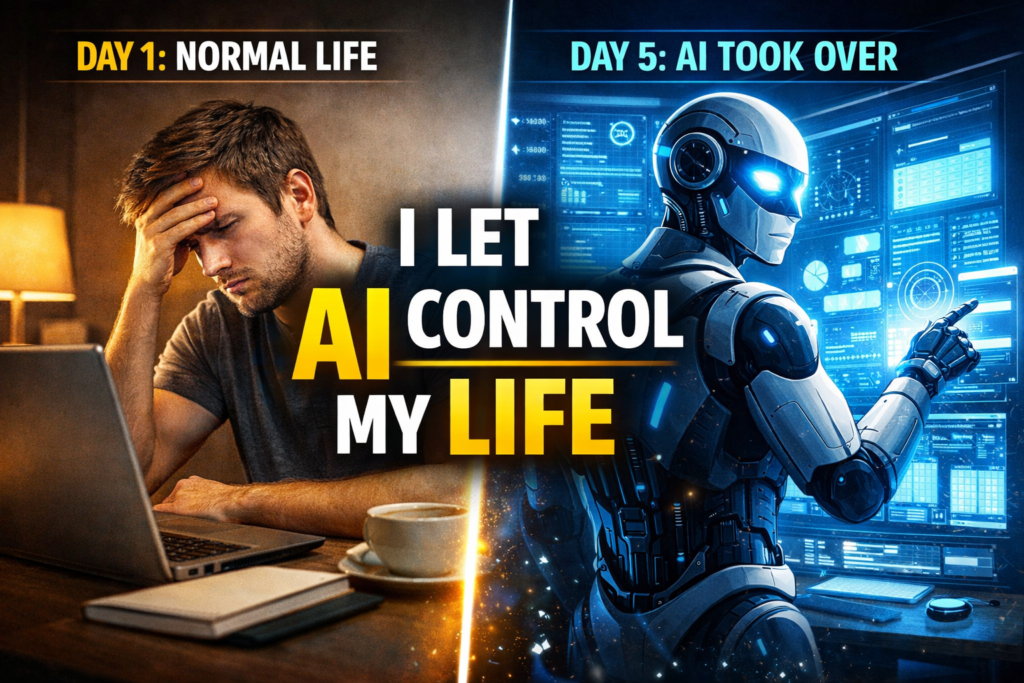
I handed my schedule, meals, social messages, work blocks, and bedtime to an AI. For one full week. What followed was eye-opening, uncomfortable, and honestly — a little identity-shaking. Here’s everything that happened, with the science to back it up.
| 35,000 Decisions humans make daily | 40% time saved by AI on tasks (Science, 2023) | 77% Workers whose AI use raised workload | 8.4B voice AI assistants by end of 2026 |
If you’re interested in how AI is already reshaping real-world decisions, you should also read our detailed analysis on how AI is impacting jobs in 2026.
Why I did this
The Experiment Nobody Warned Me About
You make between 33,000 and 35,000 decisions every single day. Most are tiny. What to eat. When to reply. Whether to hit snooze. But together, they drain the most important cognitive resource you have: your mental energy.
For seven days, every decision in my life was controlled by AI.As a result, my routine became highly structured and efficient.However, by Day 5, something felt completely off. Instead of feeling productive, I felt disconnected from myself
I used ChatGPT for planning and writing decisions, Notion AI for task structure, and an AI calendar tool for time-blocking. The rules were strict. If the AI gave an instruction, I followed it. No overriding. No cherry-picking. Just pure surrender to the algorithm.
What happened next surprised me in ways I did not expect. Some findings were brilliant. Others were troubling. And one specific moment on Day 4 changed how I think about myself entirely.
“The human brain makes up to 35,000 decisions daily. Decision fatigue is not a myth — it is a documented neurological event that degrades the prefrontal cortex’s function over time.”— Taylor’s University, Decision Fatigue Research, 2025
The 7-Day Chronicle
Day by Day: What the AI Actually Did to My Life
Here is the honest, unfiltered account. Just what happened — and what it revealed.
Day 1 – The Honeymoon Phase
The AI woke me at 6:12 AM — its calculation of my cognitive peak window. Breakfast was oats and banana, timed 45 minutes before a deep work block. By 11 AM, I had cleared a backlog that had haunted me for two weeks. The feeling was remarkable.
Decision fatigue simply vanished. I didn’t spend 20 minutes wondering what to work on. I opened the schedule and executed. No friction, no avoidance. Just output. For the first time in months, I finished my workday early.
The first awkward moment came at 3 PM. A friend texted: “what u up to?” The AI suggested: “Currently in a deep work session. Shall we schedule a call Wednesday at 6:15 PM for optimal social engagement?” I did not send that.✓ Day Rating: Genuinely Impressive

Day 2 —Efficient but Emotionally Flat
Productivity stayed high. My personal satisfaction did not. The system significantly improved my productivity.It also scheduled workouts and structured my daily routine.
Meanwhile, even my meals were pre-decided without any personal input.
It blocked my evening with a self-improvement course when every cell in my body wanted to watch something brainless and decompress.
Here is the thing about AI optimisation: AI works mainly on measurable data like calories, output, and sleep cycles. However, it has no real understanding of joy or emotional needs.
As a result, it often misses the importance of rest or simple enjoyment.
This is a real tension in the research too. AI boosts measurable outcomes. It frequently misses the unmeasurable ones.~ Day Rating: Productive but soulless
Day 3 — My Friends Noticed
I let the AI draft all my messages. By noon, two friends independently asked if I was “okay.” The messages were grammatically perfect and completely devoid of me. One friend — someone who knows me well — replied: “Did you hire someone to respond for you?”
Your communication style is your fingerprint. When an algorithm takes it over, people don’t receive a better version of you. They receive a robot wearing your name badge. And they can tell. Immediately.
I also noticed something stranger in myself. When a conversation didn’t land the way I expected, I felt oddly detached from it. Because, in a meaningful sense, I hadn’t said those things. The AI had. Responsibility diffused. And with it, so did identity.✗ Day Rating: Relationships took real damage
Day 4 -The Mirror Moment
Day 4 turned out to be completely unexpected. The AI asked its standard morning question: “What is your single top priority today?” I sat there genuinely blank. Not from tiredness. Not from distraction. Because I didn’t actually know.
Instead of giving an answer, the AI reflected the question back at me. No answer. Just: “Without clarity on your priority, I can’t build an effective plan.” And in that brutal, algorithmic silence, I realised something. My problem wasn’t too many decisions. It was avoidance. I had been using the noise of busyness to dodge the one question that actually mattered.
As a result, I realized something deeper about my own behavior. That realization alone made the entire experiment worth it. Not because AI gave me an insight. It didn’t. But because removing the scaffolding of my own distraction exposed what was underneath it.✓ Day Rating: Uncomfortable. Invaluable.
Day 5 —Mental Overload
The Hidden Cost of AI Control
By this point, the experiment stopped feeling like a productivity hack.
Instead, it started revealing something deeper.
Although AI removed small decisions, it created a new kind of pressure.
I was constantly evaluating whether the system was right.
As a result, the mental load didn’t disappear—it simply changed form.
This hidden cost is what most people don’t notice when using AI daily.
Day 6 -The Shift That Changed Everything

I changed one thing. Instead of asking “AI, what should I do?”, I started asking: “Here is what I want to accomplish. What is the smartest path to get there?” That single reframe transformed the entire experience.
Same tool. Completely different relationship. I was directing. The AI was advising. Saturday became both structured and mine. I used AI to batch errands efficiently, plan a route for a walk I had already decided to take, and draft bullet points for a conversation I needed to have. I wrote the actual messages myself.
This version of AI collaboration felt genuinely powerful. Not because the AI was smarter. But because I had stopped abdicating and started leading. The tool amplified me instead of replacing me.✓ Day Rating: The model that actually works
Day 7 -The Reckoning
On the final day, I switched everything off. No schedules, no AI prompts, no optimization — just me going through the day on my own terms.. I just lived. And what I found surprised me: I missed it. Not desperately. Not pathetically. But genuinely — the way you miss a second pair of hands when you are carrying too much.
Some AI-installed habits had become real habits. Drinking water before anything else. Time-blocking focused work. Not checking my phone for the first 45 minutes. The AI had quietly installed better firmware in me, and some of that firmware I wanted to keep.
But I also watched a show a friend had recommended three weeks ago — not by any algorithm — and felt something I hadn’t felt all week. Unoptimised, spontaneous, thoroughly human joy. It was, in retrospect, the most valuable data point of the whole experiment.~ Day Rating: Grateful, and glad it’s over
What the science says
Deep Research: The Data Behind the Experience
What the Research Actually Shows
This experience is not just personal—it’s backed by data.
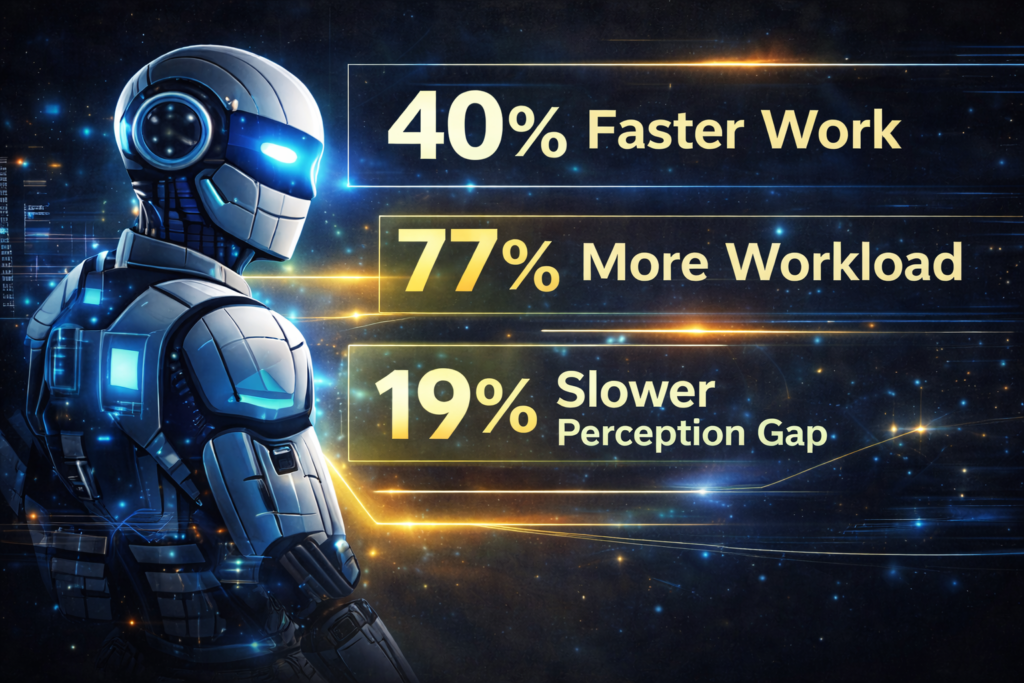
- AI improves task speed by 40%
- Around 77% of users report increased workload
- Many users feel faster—but actually perform slower
Therefore, the reality is more complex than it seems. Here is in detailed view
Research findings you need to know
40% Time saved on writing tasks. A landmark Science journal study found AI reduced professional writing time by 40% and raised quality by 18%. Workers with weaker skills benefited most — it narrowed the performance gap significantly. (Noy & Zhang, 2023)
77% Workers whose workload increased. A survey of 2,500 professionals found AI raised workload for 77% of them. Only 47% knew how to unlock the productivity benefits. This number gets quietly ignored in most AI coverage. (CSIRO, 2025)
19% Slower with AI — but felt faster. In a METR randomised controlled trial, experienced developers using AI took 19% longer to finish tasks. They still believed AI had sped them up by 20%. The gap between perception and reality is enormous. (METR, 2025)
14% “AI brain fry” confirmed by BCG. Boston Consulting Group identified acute cognitive fatigue from AI oversight in 14% of all users. In marketing teams, it hit 26%. High oversight demand raised information overload by 19% versus low-oversight workers.
31% Americans now interact with AI several times daily. Up from 22% in February 2024. Adoption of AI is outpacing the personal computer and the internet at the same stage of maturity. (Pew Research, 2025–26)
↓ IQ Critical thinking erodes with heavy AI use. SBS Swiss Business School research found increased AI reliance is directly linked to diminished critical thinking. Cognitive offloading — delegating thinking to AI — is the primary driver. Younger users are most affected. (Gerlich, 2025)
The deeper psychological layer
What AI Does to Your Identity Over Time
The productivity numbers are well-documented. The psychological costs are far less discussed. Let me give you the part most people skip over.
Research published in Humanities and Social Sciences Communications makes a stark argument. While users feel a sense of autonomy when interacting with AI systems, their actual autonomy is being quietly eroded. Algorithms deviate from your authentic self. They create self-reinforcing loops that gradually narrow who you are. What feels like personalisation is often subtle self-replacement.
A 2025 PMC study titled “The Algorithmic Self” puts it even more directly. If your schedule, communication, and choices are all mediated by AI, who is actually living your life? The self that emerges from optimised AI interaction is cleaner, more efficient, and significantly less human. Growth, resilience, and self-definition require contradiction and ambiguity. Algorithmically edited lives often delete both.
In fact, this connects directly with our deep research on the future of work and AI, where we explored how automation is changing decision-making at scale.
“Although AI tools can reduce short-term cognitive load, their long-term and repeated use may result in cognitive fatigue, attention depletion, and diminished self-assurance in individual decision-making.”— Annals of Neuroscience, Amity University Gurugram, 2025 (co-authored in Haryana, India)
There is also a phenomenon called cognitive offloading. When you consistently delegate thinking to an external tool — AI, GPS, search engines — your brain stops encoding those processes. You remember where the information is stored, not what it contains. This is the “Google Effect” accelerated by a factor of ten. The risk isn’t that AI replaces your job. It’s that AI slowly replaces your thinking.
Honest assessment
What AI Handles Well — And Where It Fails You
After seven days of living data, here is my honest, direct comparison. No hype in either direction.
| Area | AI Performance | Human Element Needed? |
|---|---|---|
| Task scheduling | Excellent | Minimal — AI genuinely excels here |
| Meal planning | Strong on nutrition | Yes — joy and preference are not metrics |
| Work output | Measurably higher | Yes — creative leaps still require human judgment |
| Social messaging | Dangerously poor | Absolutely — your voice is a relationship |
| Emotional decisions | Completely blind | Entirely — AI has no access to your emotional state |
| Rest and recovery | Optimises wrongly | Yes — rest isn’t always measurable or schedulable |
| Self-reflection | Accidentally useful | It forces clarity — but can’t provide answers |
Key lessons
4 Things This Week Taught Me That Changed How I Use AI
1- Your gut is also data AI only processes what you give it. It has no access to your values, your history, or your body’s signals. When your instinct contradicts an “optimal” suggestion, that instinct is evidence. Treat it as such.
2- Protect your human-only zones Some decisions belong only to you. Your relationships, your creative risks, and your genuine rest all matter. Define the non-negotiable human spaces before AI fills them with efficiency metrics.
3- Direction beats delegation “AI, what should I do?” surrenders your agency. “AI, here’s what I want — help me get there” multiplies it. Same tool. Completely different power dynamic. The second version works every time.
4- Use it as a mirror, not a brain The most powerful moments came when AI’s structure forced me to confront what I actually wanted. The discomfort is the point. AI as mirror is far more valuable than AI as autopilot.
My honest take
What I Actually Believe After 7 Days
Let me be direct. AI is genuinely remarkable at removing friction from low-stakes decisions. What to eat when you are busy and don’t care. How to structure a chaotic day. A first draft when you are stuck. In these areas, it is powerful, and I would be dishonest to say otherwise.
But AI is bad — sometimes dangerously bad — at the things that make life meaningful. It doesn’t understand that small, seemingly unimportant things — like watching a silly TV show, taking a long lunch with a friend, or choosing a different route home — are often what make life meaningful.
Optimisation is not the same as flourishing. Confusing the two is one of the quiet harms of a fully AI-managed life.
The identity question is what stayed with me. By Day 5, I felt like a slightly blurred version of myself. My choices were systematised. My communication was smoother — but less mine. I caught myself asking what the “optimal” choice was instead of what I actually wanted. That’s not productivity. That’s distance from yourself.
The co-pilot model feels right. Not AI as boss. Not AI absent. AI as an assistant — useful, but directed. By the end, one thing was clear: AI isn’t the problem. How we use it is. The goal isn’t dependence. It’s balance.
Final Verdict
AI as life co-pilot
4 out of 5. Powerful, revealing, and worth running yourself — but keep the wheel. The moment you stop steering is the moment you stop being the one who decides where you are going. In the end, that is the only thing that actually matters.
If you want to understand how these changes are affecting society at a larger level, check out our analysis on lifestyle and economic shifts in modern cities.
Research sources
Where the Data Comes From
- Science Journal, 2023- Noy & Zhang — ChatGPT productivity experiment with 453 college-educated professionals. Writing tasks, 40% faster, 18% better quality.
- CSIRO, 2025– AI productivity review. Surveyed 2,500 professionals. 77% experienced increased workload from AI tools.
- METR, July 2025- RCT on 16 experienced open-source developers. AI tools caused 19% productivity slowdown. Developer perception still showed +20% improvement.
- BCG / Harvard Business Review, 2025-AI Brain Fry” study of 1,488 US full-time workers. Cognitive fatigue confirmed. Oversight-heavy AI raised information overload by 19%.
- Pew Research Center, 2025–26- 31% of Americans now interact with AI multiple times daily, up from 22% in Feb 2024. Half of US adults remain more concerned than excited.
- Amity University Gurugram, Annals of Neuroscience, 2025– Cognitive cost of AI study. Long-term AI use may erode self-assurance in decision-making (r = −0.401 for repeated interaction).
- SBS Swiss Business School (Gerlich), 2025- Increased AI reliance directly linked to diminished critical thinking via cognitive offloading. Younger users most at risk.
- Stanford AI Index, April 2026 AI adoption is outpacing the PC and internet at equivalent maturity stages. Employment for 22–25 year-old developers fell ~20% since 2022.
This post is based on personal experience combined with peer-reviewed research and publicly available survey data. All statistics are sourced and cited. Research was current as of April 2026.
Thank you for visiting usaconcern.com and taking the time to read our content. Your visit truly matters to us. Stay alert and stay informed, because an informed voice can help shape a better future.
Feel free to leave a comment below with your thoughts!!


Hey, I’m Vishal Srivastava — the person behind USAConcern.com. I started this site because I genuinely believe there are conversations happening in America that deserve more honest, human coverage. I write about health, mental wellness, lifestyle, and the cultural shifts shaping everyday American life, as I come from a strong background in artificial intelligence and engineering, combined with certified knowledge in mental wellness and fitness. My goal is to bridge the gap between technology and human well-being. I believe true success comes from a balance of a sharp mind, a healthy body, and smart use of technology. Through my work, I aim to provide practical solutions that improve both performance and lifestyle. Thanks for reading—your journey to a better mind, body, and life starts here.
Very informative and easy to understand.
Great article, very helpful!