
Millions of Americans go to bed fine. They wake up at 3 AM and reach for their phones. What they type next — into the only space that doesn’t judge them — is a confession the whole country needs to hear.
What people search for at 3AM reveals deep psychological patterns that most of us would never admit to in the daylight—patterns of fear, loneliness, shame, and quiet desperation that we spend every waking hour trying to conceal. The search bar doesn’t know that, of course. It doesn’t judge or hesitate. It simply accepts whatever you type, then returns a list of blue links.
And so, somewhere between midnight and 4 AM, tens of millions of Americans tell Google the truth that they can’t tell anyone else.
This isn’t insomnia causing aimless browsing. This isn’t boredom. What happens in those hours—when the performance of okayness finally exhausts itself and the house goes quiet—is something far more significant. It’s a country confessing, in aggregate, what it’s actually going through. And the data, when you look at it honestly, is devastating.
Researchers who study search trends have documented the same pattern for years: searches related to anxiety, depression, loneliness, relationship breakdown, financial collapse, and existential dread spike sharply after 11 PM and reach their highest intensity right around 3 in the morning. Furthermore, studies published in peer-reviewed journals have confirmed that these patterns correlate directly with real-world mental health outcomes—emergency department visits, therapy uptake, medication use, and unmet mental healthcare needs. In other words, what America types into Google at 3 AM is not random. It is, quietly, a distress signal.
| 103M Sleep-related searches in America every year | 1 in 5 U.S. adults feels lonely every single day | 69% of adults got less emotional support than they needed last year |
The anatomy of a 3 AM search
To understand why this matters, you first have to understand what a 3 AM search actually is.
It is rarely curiosity or research. More often, it’s something a person has carried all day—the worry hidden behind polite smiles, the fear brushed aside at dinner, the doubt buried beneath distraction—finally surfacing in the one moment when nothing remains to keep it quiet.
Psychologists who study nocturnal rumination have long understood that the brain, without daytime stimulation and social performance to occupy it, defaults to unresolved anxiety. Moreover, the cognitive controls that help us minimize and rationalize our fears are significantly weakened at night.
So the thing that felt manageable at 2 PM feels catastrophic at 3 AM. And instead of lying there alone with it, people do the only thing available to them: they open Google.
By the time the clock slips past midnight, something changes. The world goes quiet—but the mind doesn’t. It gets louder. Sharper. Less filtered.
Researchers have noticed a pattern: people struggling emotionally don’t just use the internet more—they use it differently. Between 6 PM and midnight, the searches get longer. Heavier. More revealing. And by 3 AM, something else entirely is happening.
This isn’t browsing anymore.
This is confession—typed into a blank search bar
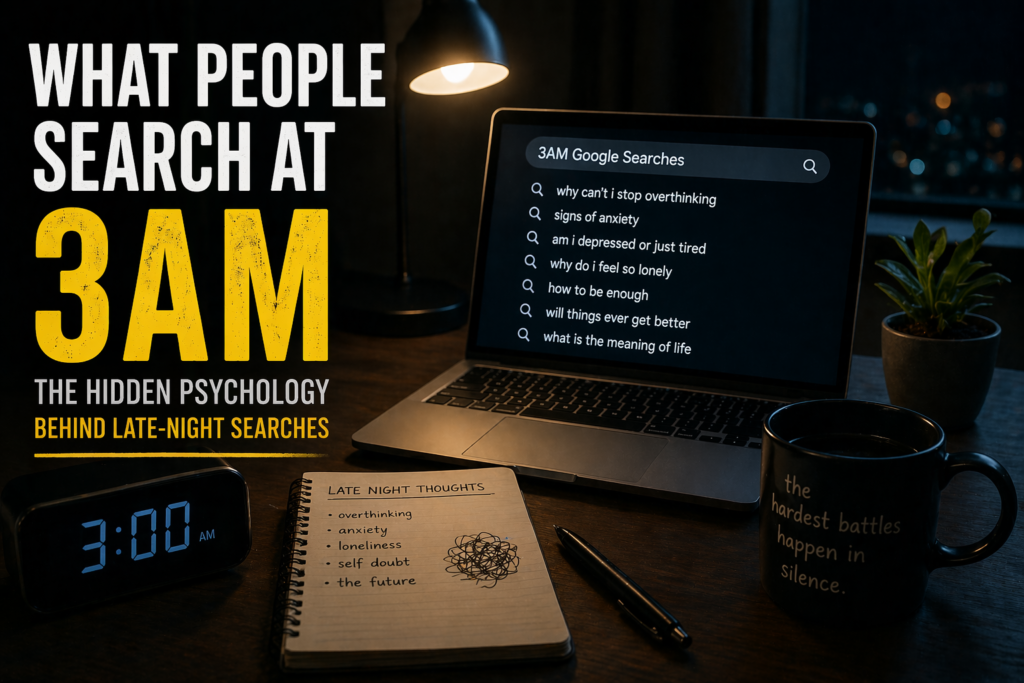
Searched by millions at 3 AM
“why do i feel so empty inside?”
This isn’t ordinary sadness. Sadness has texture—you can feel it, name it, point to it.
This is the absence of that. A kind of emotional silence.
It’s what happens when feelings have been pushed down for so long that they stop surfacing at all. No clear reason. No obvious trigger. Just a dull, persistent nothing.
And the people searching this?
They’re rarely the ones others worry about. They function, show up, and smile at the right moments. They’ve learned how to perform “okay” so convincingly that even they almost believe it—until the quiet hours strip that performance away.
“Am I having a heart attack or anxiety?”
Late-night health searches peak between 3 and 4 AM. They almost never begin with the symptom—they begin with the fear underneath the symptom. A terror about mortality. About losing control over the one thing you thought you could count on. The chest tightness becomes a cardiac event. The anxiety about dying creates a physical spiral that genuinely mimics the thing it fears.
“is my partner cheating on me?”
Trust-related searches peak specifically at this hour. And interestingly, in most cases, nothing concrete triggered the search. Instead, 3 AM simply removes every cognitive buffer between a person and their deepest insecurities. The suspicion that was a whisper at 9 PM becomes a conviction at 3 AM—not because the evidence changed, but because the defenses did
The search bar has become America’s confessional — and what gets typed in the dark reveals a country quietly drowning in things it doesn’t know how to say.
Hour by hour: what America types when the world goes quiet
The night tells its story in chapters. Each hour has its own specific character, its own species of anxiety, its own pattern of desperation. And once you see the pattern, you can’t unsee it.
11 PM The transition
“how to stop overthinking” / “sleep sounds 10 hours”
The day’s unprocessed stress begins to surface. People try to manage it—rain sounds, guided meditation, and ASMR. Americans search for insomnia-related terms over 12 million times a year, and the surge begins right here. At this hour, people still believe they can fix it. They’re still trying the tools.
1 AM The reckoning
“signs of depression” / “Do I have anxiety?”
The tools haven’t worked. Now the searching turns inward. Research tracking Google Trends data from 2018 through 2024 confirms that depression and anxiety searches rise sharply toward late evening and continue climbing through midnight. Importantly, these search patterns correlate directly with real emergency department visits and mental health service usage. This is not people being dramatic. This is the first honest look in the mirror many of them have had all day.
2 AM The financial spiral
“how to make money fast” / “How much debt is normal”
Money anxiety takes over in this window. A Harvard Kennedy School study found that 42% of Americans under 30 say they’re barely getting by financially. More than half of Gen Z says they don’t earn enough to live the life they want. These are people who did everything right — studied, worked, tried to save — and still can’t make the math work. At 2 AM, that reality has nowhere left to hide.
3 AM The raw hour
“why do i have no friends?” / “Signs your marriage is failing”
This is the rawest hour. Denial has fully exhausted itself. The searches happening right now are the ones that have been waiting all day, held back by every meeting, meal, and social performance that daylight provides. This is when people finally let themselves ask the thing they’ve been most afraid to ask—because there’s literally nothing left to stop them.
4 AM The existential shift
“what is the meaning of life?” / “Does anyone actually care about me?”
Something strange happens in this final hour. After the panic of 3 AM comes a kind of exhausted stillness. Health anxiety searches reach their peak early in this window, then the questions shift to something bigger and quieter. Not what’s wrong with my body—but what’s the point of all of this? It’s the most honest question of the night, and it arrives when the person is too tired to be afraid of asking it.
130 million people, alone in a country full of people
Before we go further, there’s a number you need to sit with. Don’t skim past—actually sit with it. 130 million American adults are navigating daily life while feeling fundamentally disconnected from the people around them. That is nearly half the adult population of the United States walking through their days with a specific, bone-deep ache that they are not talking about.
A 2024 Gallup study confirmed that one in five American adults feels lonely every single day. Not occasionally. Not in difficult patches. Every day, the American Psychiatric Association put the weekly figure at 30% of all adults. And then there is the finding that truly deserves to be front-page news: young adults aged 18 to 34 are the loneliest generation in the country — far lonelier than the elderly population that everyone assumes is most at risk.
Think about what that actually means. The generation that grew up with smartphones, social media, and always-on connection—the generation that should theoretically never be alone—is the most isolated generation in recorded American history. About 30% of Americans aged 18 to 34 report feeling lonely every day or multiple times a week.
Additionally, roughly two in ten American adults have no close friends outside of family at all. In 1990, that number was 3%. Something has fundamentally broken.
What broke, piece by piece
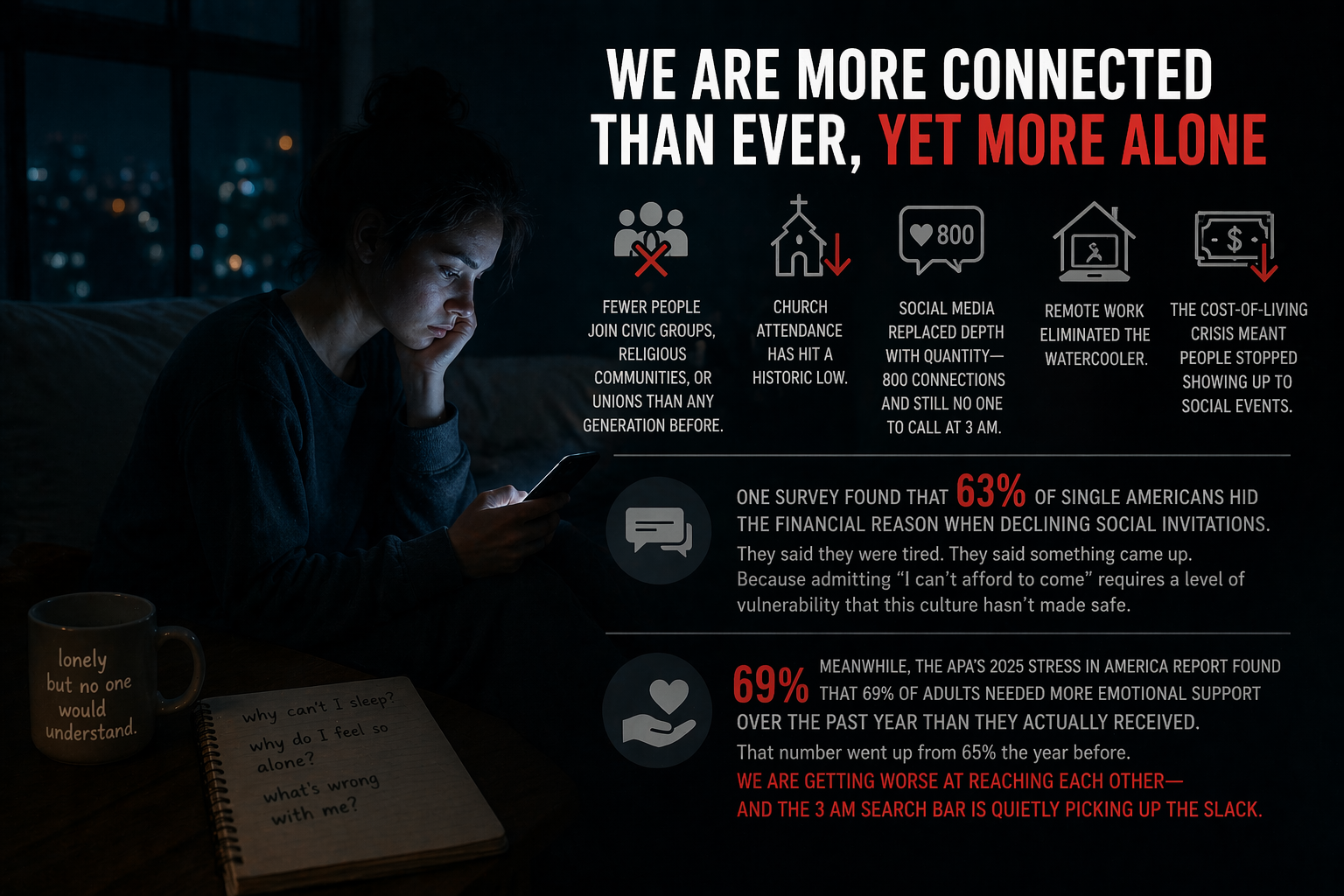
Fewer people join civic groups, religious communities, or unions than any generation before them. Church attendance has hit a historic low. Social media replaced depth with quantity — you can have 800 connections and still have nobody to call at 3 AM. Remote work eliminated the watercooler. The cost-of-living crisis meant people stopped showing up to social events — not because they didn’t want to, but because they literally couldn’t afford to.
And then, crucially, they lied about why. One survey found that 63% of single Americans hid the financial reason when declining social invitations. They said they were tired. They said something came up. Because admitting “I can’t afford to come” requires a level of vulnerability that this culture hasn’t made safe. So the silence grew. And with every declined invitation, the isolation compounded.
Meanwhile, the APA’s 2025 Stress in America report found that 69% of adults needed more emotional support over the past year than they actually received. That number went up from 65% the year before. We are getting worse at reaching each other—and the 3 AM search bar is quietly picking up the slack.
The mental health tsunami that was already coming
When researchers at Tulane University analyzed Google Trends data and documented a massive spike in panic attack searches, one psychologist used an image that stayed with me. He called what was building a “mental health tsunami.” Not a wave. A tsunami — something gathering silently far offshore, invisible from the beach, until it isn’t.
That tsunami has been building for years. Research mapping depression-related search intent across the United States — tracking terms like “feeling sad,” “feeling empty,” “insomnia,” and “depressed” — found a steady climb through the 2010s and into the 2020s, with a massive acceleration beginning around 2020 that never fully reversed. The prevalence of depression symptoms in the U.S., which stood at around 18.5% before the pandemic, jumped to 27.8% afterward, affecting an estimated 91 million Americans. And those are not people who received diagnoses. Those are people who were living with symptoms, searching Google instead of seeing a doctor, because seeing a doctor costs money and time and requires admitting out loud that something is wrong.
The APA’s 2025 report found, furthermore, that more than half of adults reported feeling emotionally disconnected — isolated from others, left out, lacking companionship — often or some of the time. These aren’t clinical patients. These are ordinary Americans, working ordinary jobs, performing ordinary lives, while quietly unraveling inside. And the Google search bar is the only place many of them let it show.
At 3 AM, the performance finally stops. What’s left is what’s real. And what’s real in America right now is something most people are carrying completely alone.
Why nobody talks about it
There is a particular cruelty in the way loneliness works as a social experience. It persuades you, specifically, that you are the only one.You go to work, and everyone seems fine. You scroll Instagram, and it looks like everyone has friends, weekends, and a sense of belonging. You sit in a restaurant, and every table seems filled with people who’ve figured something out that you haven’t.
The curated performance of modern life has never been more convincing — and the gap between the life people perform publicly and the life they actually live has never been wider. As a result, the shame compounds. Because not only are you struggling — you believe you are the only one struggling. And that belief, above everything else, is what sends people to Google at 3 AM instead of picking up the phone.
The geography of this crisis is not what you’d expect, either. It’s not the rural, the elderly, the obviously isolated. A 2024 Census Household Pulse Survey found the highest loneliness rates in Alaska, Oregon, and West Virginia. Las Vegas, Washington D.C., and Denver are the three loneliest cities in the country — with loneliness rates three times the national average. More than half of American workers — not retirees, not teenagers, but working adults in the prime of their careers — classify as lonely. The economic toll alone is estimated at $406 billion annually in absenteeism and lost productivity. Furthermore, social isolation carries mortality risks equivalent to smoking fifteen cigarettes a day. This is not a soft lifestyle issue. This is a structural failure.
What the searches are actually asking for
Here is what gets lost when this topic gets discussed in charts and policy briefs. These are not data points. They are people. The person searching “why do I feel so alone even when I’m surrounded by people” at 3:22 AM on a Wednesday is a real human being lying in a real bed, probably with a partner sleeping beside them who has no idea what’s happening two feet away. The person searching “how do I know if my marriage is over” for the fourth time this month is someone who has been telling themselves they’re fine while quietly building a case for a decision they’re terrified to make.
The reason they’re telling Google instead of a friend is because Google is the only space left in their life where they don’t have to manage how they’re perceived afterward. The 3 AM search is reaching out with all the vulnerability removed. It is what asking for help looks like in a culture that has, methodically and without really meaning to, dismantled every informal place where people used to just be together: the church hall, the union meeting, the neighborhood bar, the front stoop, the family dinner where everyone actually stayed at the table.
We removed all of that. And then we acted surprised when everyone went home and felt alone. So we built apps to fix it—yet somehow, they made it worse. Scrolling isn’t the same as talking, liking isn’t the same as caring, and a follower count isn’t the same as being known.
The bridge that doesn’t exist yet
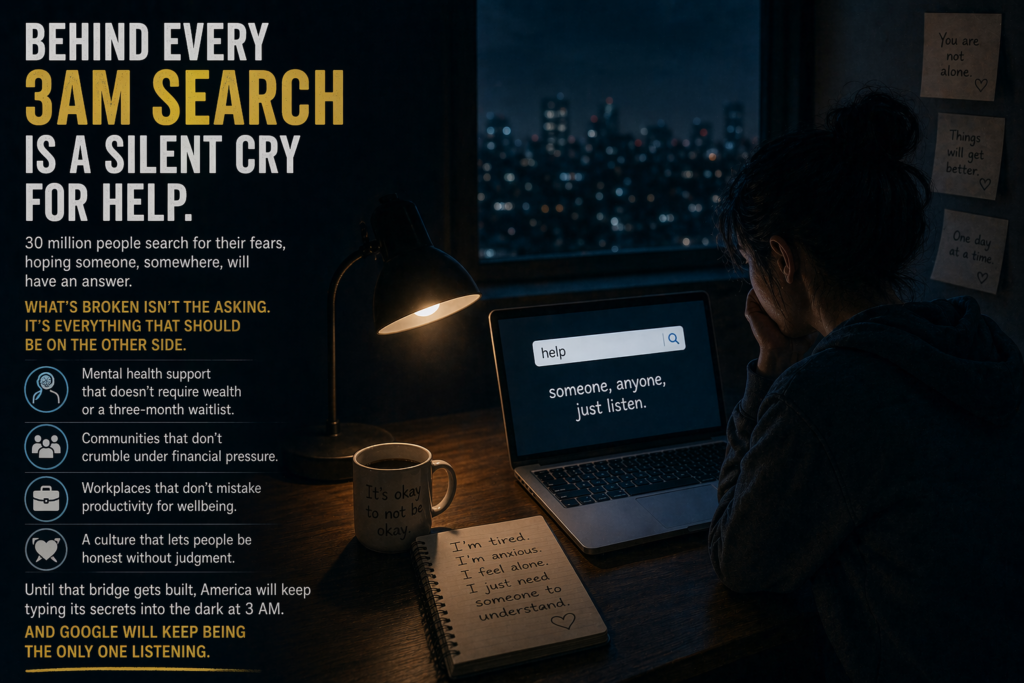
There is something in this data that, despite everything, is not despair. Because what the 3 AM search represents — underneath all the fear and shame — is the impulse to ask. To reach, even blindly, into the dark and hope something answers back. That impulse has not been broken. Thirty million people searching for the same fears, in the same quiet hours, in the same darkened rooms across a country that looks from the outside like it’s doing fine — that is not a country that has given up. That is a country that is still trying to find a way to say what it’s going through.
Because what’s broken is not the asking. What’s broken is what should be on the other side of it — mental health support that doesn’t require wealth or a three-month waitlist, communities that don’t crumble under financial pressure, workplaces that don’t mistake productivity for wellbeing, and a culture that has somehow forgotten how to let people be honest about what they’re carrying without immediately judging it or scrolling past it.
Until that bridge gets built — and it hasn’t been, not really, not in any serious way — America will keep typing its secrets into the dark at 3 AM. And Google will keep being the only one listening.
Which is, when you think about it, the saddest search result of all.
And if you’re being completely honest with yourself…
what have you searched at 3AM that you’d never have the courage to say out loud to another human being?
Frequently Asked Questions
Why do people think more at night?
People tend to think more at night because distractions are reduced and the brain shifts inward. Without work, social interaction, or noise, unresolved thoughts and emotions become more noticeable, often leading to overthinking.
What happens to the brain at 3AM?
Around 3AM, the body reaches one of its lowest points in terms of alertness, body temperature, and energy. This state can make emotions feel stronger and thoughts more intense, which is why anxiety and deep thinking often peak at this time.
Why does anxiety increase at night?
Anxiety often increases at night because the mind is no longer distracted by daily activities. Suppressed worries and stress from the day resurface, and with fewer coping mechanisms available, they can feel more overwhelming.
Are late-night Google searches normal?
Yes, late-night Google searches are very common. Many people use search engines at night to process emotions, find reassurance, or explore thoughts they may not feel comfortable discussing openly.
What do 3AM thoughts mean psychologically?
3AM thoughts are usually linked to unresolved concerns, emotional stress, or deeper psychological patterns. They are not random—they often reflect what the mind has been avoiding or suppressing during the day.
Why do people search personal questions on Google at night?
People often search personal or sensitive questions at night because it feels private and judgment-free. The quiet environment makes it easier to confront thoughts and emotions they might avoid during the day.
Sources: Gallup 2024 Loneliness Data · American Psychiatric Association Healthy Minds Poll 2024 · APA Stress in America 2025 · Amerisleep / Google Trends Sleep Research (103M annual searches) · Tulane University Google Trends Mental Health Study · Nature Scientific Reports — Internet Searches as Mental Health Markers (2022) · JMIR Mental Health Depression Mapping Study (2022) · Harvard Kennedy School Financial Wellbeing Survey 2025 · USC Financial Strain & Loneliness Study 2025 · Cigna U.S. Loneliness Index 2025 · U.S. Census Bureau Household Pulse Survey 2024 · CFP Board Financial Loneliness Survey 2026

Hey, I’m Vishal Srivastava — the person behind USAConcern.com. I started this site because I genuinely believe there are conversations happening in America that deserve more honest, human coverage. I write about health, mental wellness, lifestyle, and the cultural shifts shaping everyday American life, as I come from a strong background in artificial intelligence and engineering, combined with certified knowledge in mental wellness and fitness. My goal is to bridge the gap between technology and human well-being. I believe true success comes from a balance of a sharp mind, a healthy body, and smart use of technology. Through my work, I aim to provide practical solutions that improve both performance and lifestyle. Thanks for reading—your journey to a better mind, body, and life starts here.