
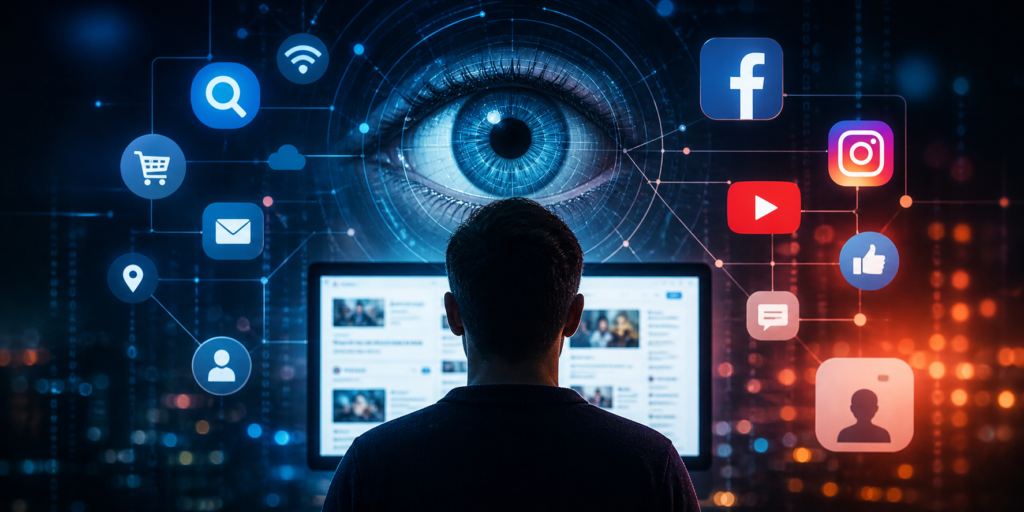
You opened Amazon to search for a pair of running shoes. Three days later, your Instagram feed is full of gym wear ads, your YouTube homepage is suggesting fitness channels, and somehow your Spotify Discover Weekly added a workout playlist you never asked for. Coincidence? Not even close.
This is not magic. It is not even particularly new. But what is happening right now, in 2025, is something on a completely different scale from what most people realize. The AI systems tracking your every click have grown so sophisticated that they are no longer just watching what you do — they are predicting what you will do next, nudging you toward it, and in some cases, engineering the very desires they then appear to satisfy.
Let that sink in for a second.

What “Tracking Your Clicks” Actually Means
Most people imagine click tracking as some IT guy in a server room watching a dashboard go ping every time someone clicks a button. That mental image is about twenty years out of date.
Today, user behavior tracking is the process of collecting and analyzing data on how users interact with apps or websites — but modern AI systems have expanded this far beyond simple click logs. They are capturing scroll depth, mouse hover patterns, how long your cursor pauses before moving, which parts of a page you re-read, when you abandon a form halfway through, and even what your so-called “rage clicks” reveal about your frustration level.
Machine learning now automatically tags session recordings with behavioral events like “rage clicks” or “excessive scrolling” to help identify user frustration — and this data feeds directly back into how platforms redesign themselves to keep you engaged longer.
Here’s what nobody tells you in the cookie consent popup, they’re not just collecting behavioral data.. It is psychological. Every hesitation, every impulse click, every abandoned cart is a data point that tells the system something about your decision-making patterns, your emotional state at the time, and your vulnerability to certain kinds of persuasion.
That is the part that should give you pause.
You’ve probably already seen how this works in practice — especially in how social platforms decide what you see next. If you’ve ever wondered why your feed feels so addictive, you’ll notice the same patterns explained in how social media algorithms actually work.
The Scale of This Is Genuinely Hard to Comprehend
Think about how many apps you opened today. Your bank. A food delivery app. WhatsApp. News sites. Google Search. Each of these, separately, knows things about you. But in a world where data brokers connect the dots between them all, and AI can process billions of behavioral signals in real time, you are not just a user — you are a behavioral profile that gets more accurate by the hour.
It is no exaggeration to say that popular platforms with loyal users, like Google and Facebook, know those users better than their families and friends do. Facebook, for example, can use Likes to predict with a high degree of accuracy various characteristics, including sexual orientation, ethnicity, religious and political views, personality traits, intelligence, happiness, and use of addictive substances.
If something as shallow as a Like button can reveal all of that, imagine what the system learns from the full picture — search keywords, how long you read a particular news story, what time of night you shop, how your scrolling speed changes when you encounter emotionally charged content.
Companies at the center of this behavioral harvesting are driving the global recommendation engine market to grow from $5.39 billion in 2024 to a staggering $119.43 billion by 2034. That kind of money doesn’t fund systems designed purely to help you. It funds systems built to maximize engagement — which is a polite word for addiction
From Tracking to Predicting: The Real Leap
Tracking your clicks is the old game. What AI does now is predict your next move before you make it.
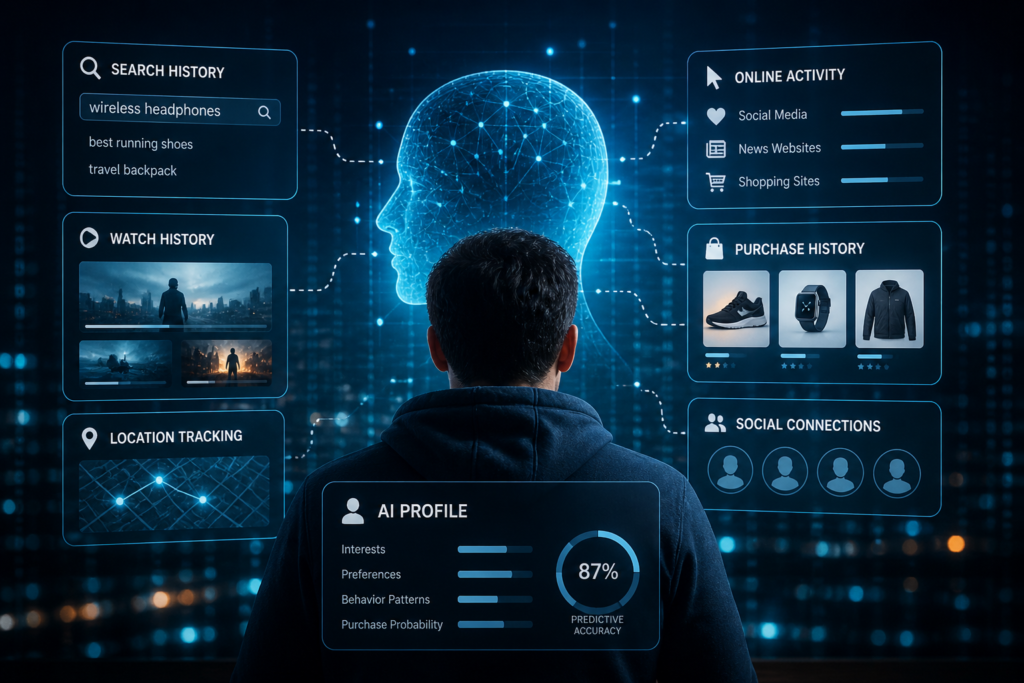
AI recommendation engines now anticipate customer needs before users explicitly express them. They achieve this by applying advanced techniques such as temporal pattern analysis and cross-domain behavioral mapping.
What this means in practice: the platform does not wait for you to want something. It shows you something it has calculated you are likely to want, based on your behavioral fingerprint, the time of day, your recent activity, and the aggregated behavior of millions of people who share your profile characteristics. By the time you feel a desire, the algorithm has already been engineering that desire for several minutes.
Algorithms are now analyzing customer interactions in real time, predicting consumer behavior and personalizing content. Marketers who once reacted to consumer behavior can now predict it and create personalized campaigns.
This is a fundamental shift in the relationship between technology and human agency. We used to use apps. Now apps use us — or at least, they use our behavioral data to construct experiences specifically calibrated to make us act in ways that benefit the platform’s revenue model, not our own wellbeing.
I find this genuinely uncomfortable to think about, and I think you should too.
The Manipulation Layer Nobody Talks About
Here is where it gets darker. The predictive engine is not neutral. It is not just showing you things you might like. It is actively steering you toward decisions that serve the platform’s interests.
According to a 2025 survey, 62% of users admit to feeling overwhelmed by the ceaseless barrage of tailored recommendations. Designers deliberately weaponize decision fatigue, turning excessive choice into something just as paralyzing as too little.
Designers call these tactics “dark patterns” — user interface designs they intentionally craft to steer users toward decisions they might not otherwise make. and AI has made these patterns significantly more powerful.
AI systems are capable of predicting decision-making and behavior from user data, which makes it possible to influence it. Reinforcement learning systems can optimally time prompts for fatigued or distracted users, increasing the likelihood that they make automatic decisions. Natural language generation can manipulate users’ emotional states in real time by rendering tones of guilt, gratitude, and encouragement toward preset preferences.
Read that again. The system learns when you’re tired or distracted and deliberately serves its most persuasive prompts at that moment. That pop-up asking you to upgrade your subscription might not be random—it may have been held back and then triggered because your scrolling slowed down, which the AI reads as low energy and reduced critical thinking.
E-commerce uses AI to create a sense of fake urgency, like “only 1 item left” or “5 more people are looking at this product right now” — notifications that can appear even when there are plenty of articles in stock or nobody else is actually looking.
This is not an edge case or the behavior of a few bad actors. This is mainstream digital commerce in 2025.
That feeling of being pulled back into apps isn’t accidental. It’s closely tied to the same mechanics behind why you feel addicted to scrolling, where small behavioral triggers are amplified over time.
The Emotion-Reading Frontier
If behavioral tracking sounds invasive, wait until you hear where this is heading.
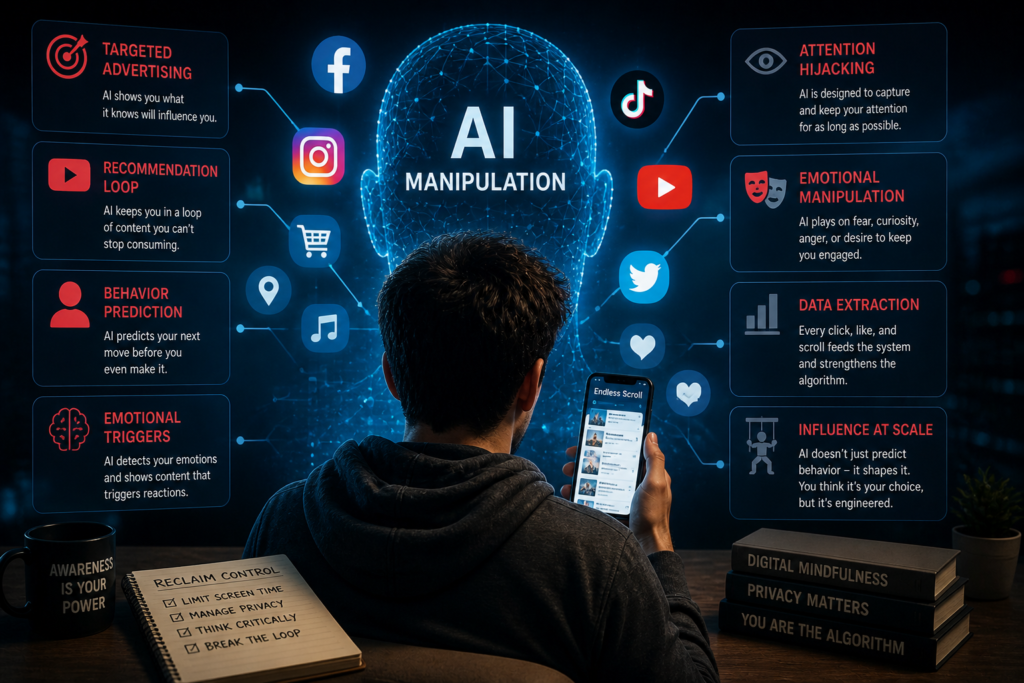
Mood-based recommendations are gaining significant attention as systems begin to detect and respond to user emotions through various means such as text analysis, voice tone, facial expressions, and behavioral patterns.
Engineers are already building emotion-aware AI into recommendation engines. These systems detect whether you’re stressed, bored, impulsive, or content, and they serve content or products calibrated to that exact emotional state. If you’re stressed, they show you comfort food. When boredom sets in and your scrolling speeds up, they push outrage-driven content to slow you down. In moments of impulse, they surface the luxury item you’ve been eyeing for weeks, they surface the luxury item you’ve been eyeing for three weeks.
This is not science fiction. Companies back this commercial strategy with billions of dollars in investment. And the troubling reality is that most users have no idea it is happening. Many AI systems collect data quietly, without drawing attention, which can lead to serious privacy breaches. These covert techniques often go unnoticed by users, raising ethical concerns about transparency and consent.
The Surveillance Capitalism Problem
There is a broader structural issue here that goes beyond individual platforms being sneaky. Companies have built the entire business model of the modern internet on surveillance.
The companies doing this have a financial incentive to collect as much data as possible, to make their behavioral profiles as accurate as possible, and to design their products to be as compulsive as possible. Restraint is literally bad for their bottom line. That is a structural problem that individual user awareness cannot fix.
Most companies benefit from manipulative AI. It increases engagement, keeps users hooked, and drives revenue. Letting models run wild is not innovation — it is negligence.
Analysts valued the global video surveillance industry at $73.75 billion in 2024 and expect it to reach $147.66 billion by 2030. Unlike older cameras that only recorded video for later review, AI surveillance can recognize faces, track people across multiple cameras, and flag unusual behavior in real time.
And this is not just online. The tracking has moved into physical space. Retail stores use computer vision to track where your eyes go on a shelf. Facial recognition estimates your age, gender, and emotional state. Loyalty programs link your in-store behavior to your online profile. Your physical world movements are becoming as legible to these systems as your clicks.
In the absence of a national privacy bill in the US, there are few legal safeguards to limit workplace computer or network surveillance. Employers can track what workers do on their computers, even when using their equipment at home. Some firms even go as far as monitoring keystrokes or facial expressions.
This is not dystopia. This is Tuesday.
What the Law Says (And Where It Falls Short)
Regulation is catching up, but it is catching up slowly and unevenly.
The EU’s GDPR requires meaningful consent for data collection, and courts have begun applying it seriously. The Dutch court found a predictive algorithm’s reliance on huge pools of personal data to contravene GDPR’s principles of data minimisation and purpose limitation. Courts in multiple EU countries have ruled that partial anonymization of data after collection is not sufficient to legitimize AI surveillance.
The EU AI Act goes further, attempting to specifically prohibit certain manipulation techniques. But enforcement is lagging behind deployment.
In the United States, the picture is more fractured. Some states have consumer privacy laws. There is no comprehensive federal framework. In 2022, New York Attorney General Letitia James fined Fareportal $2.6 million for using deceptive marketing tactics to sell airline tickets. That is real, but $2.6 million is not a serious deterrent for companies making billions from behavioral data.
The harder truth is that even well-intentioned regulation struggles with the fundamental asymmetry here: these companies have billions of dollars, armies of engineers, and years of head start. Regulators are always running a few generations behind the technology they are trying to govern.
The Consent Illusion
Every time this topic comes up, people say, “But you agreed to the terms of service.” Let’s address that.
No. You did not—not in any meaningful sense.
Companies train many AI models on publicly available data that people never intended for large-scale AI processing, ignoring a central pillar of privacy law: individuals should remain in control of their data through informed consent.
When a company requires you to accept a 50-page terms of service just to use a service you need for work or social connection, it doesn’t obtain consent—it forces capitulation dressed up as choice. And companies know this.
When Meta tried to push users to opt into AI training, it used dark patterns—misleading email notifications, redirects to login pages, and hidden opt-out forms that were hard to find. Even when users located those forms, the system required them to justify opting out. Designers didn’t make these choices by accident. They deliberately added friction to exhaust resistance.
This is the consent illusion: companies technically give you a choice, but they engineer the system so that the option they want feels like the easiest path.
The Surprising Part: What AI Does With Your Data You Never Expected
Here’s your passage in active voice, tightened while keeping your tone and buildup:
Here’s the part the headline promised—and the point I’ve been building toward all along.
You might assume companies use your data to sell you more stuff. They do, but that’s the boring part. The more surprising applications go much further.
Companies can use your behavioral data to infer details about your health. Searching patterns, app usage, scroll behavior, and purchase history can indicate depression, anxiety, pregnancy, or chronic illness before you have discussed these things with a doctor — or anyone. This information finds its way into pricing models for insurance, lending decisions, and employment screening in ways that are largely invisible to you.
Your political views, as mentioned earlier, are inferable from behavioral data even if you never discuss politics online. This has obvious implications for targeted political content and, at a more alarming level, for government surveillance programs.
Using federal datasets this way raises privacy law concerns because they contain a lifetime of sensitive details about you, including biographical, employment, and tax information.
And there is the broader societal distortion: AI Overviews reduce clicks to websites on average 34.5%, with informational queries seeing the highest reduction. What this means is that the AI systems mediating your information diet are increasingly deciding what information you receive, in what framing, with what emphasis — without you ever seeing the sources that information came from or being able to evaluate them yourself.
Companies aren’t just selling you products—they’re shaping your decisions.. Your perception of reality is being curated by systems with financial incentives that have nothing to do with your understanding of the world.
So What Do You Actually Do About This?
I want to be straight with you: there is no clean solution here. You cannot opt your way out of surveillance capitalism while living a fully connected modern life. But there are things worth doing.
First, understand the game they’re playing. Knowing that the platform is engineering your emotional state and timing its prompts for moments of fatigue changes how you interact with it. Recognition is not immunity, but it is resistance.
Second, use tools that reduce the data surface.Privacy-focused browsers, tracker blockers, and DNS-level ad filtering significantly reduce how much data companies can collect about you.
. They are not perfect, but they reduce the behavioral footprint you leave.
Third, create deliberate friction between impulse and action. Companies build the entire system to eliminate that friction—so put it back. Wait 24 hours before making a purchase you hadn’t planned. Recognize artificial urgency for what it is. Most consumers worry about how companies use their data, yet they still trade privacy for personalization. When you recognize that you’re part of that majority—that both the anxiety you feel and the choice you make are engineered outcomes—you at least have a starting point.
Fourth, support regulation. Consumer protection law, privacy rights, and corporate accountability in this space are not inevitable — they require political will that only comes from people who understand the stakes and demand action.
The Deeper Question
At some point, this stops being a technology discussion and becomes a philosophical one.What does human autonomy mean in a world where companies have designed the systems around your every digital move to anticipate, shape, and direct your choices?
You are being steered — but it feels like your idea. AI systems don’t just repeat messages — they optimize them. Algorithms analyze human behavior at scale and fine-tune content for persuasion.
That is the uncomfortable truth at the center of all this. The tracking is not the end goal. The prediction is not the end goal. The end goal is influence — reliable, scalable, monetizable influence over human behavior. And the more sophisticated these systems become, the more seamlessly that influence blends into what feels like your own free will.
We are only at the beginning of this. The systems described in this piece will become the primitive ancestors of what companies build over the next decade. Emotion-aware AI, always-on ambient computing, and the continued collapse of the boundary between physical and digital space will make today’s behavioral tracking look quaint.
The question is not whether to be alarmed. The question is what we decide to do with that alarm before the window to do something about it closes.
Final Thought
Each click becomes a data point. Those data points stack into a profile. Companies then use that profile to build systems that more effectively influence your next decision. This is not paranoia — it is the stated business model of most of the technology you use every day.
The surprise is not that the tracking exists. It is how far beyond tracking it has already gone — and how thoroughly normal it has become to live inside a system designed to know you better than you know yourself, and use that knowledge against you.
You deserve to know that. What you do with the knowledge is up to you. For now, anyway.
Have thoughts on this? Drop them in the comments. And if this opened your eyes to something you hadn’t considered before, share it — the more people understand how this works, the harder it becomes to get away with.
FAQs
Does AI really track everything I do online?
Not everything, but far more than most people assume — especially patterns, timing, and behavior signals.
Can I stop it completely?
No. But you can reduce how much you reveal and how predictable you are.
Why do recommendations feel so accurate?
Because they’re built from both your behavior and patterns seen across millions of similar users.
Closing
If this made you pause for a second and look at your screen differently, pass it on.
Most people still think this is just about ads.
It isn’t.

Hey, I’m Vishal Srivastava — the person behind USAConcern.com. I started this site because I genuinely believe there are conversations happening in America that deserve more honest, human coverage. I write about health, mental wellness, lifestyle, and the cultural shifts shaping everyday American life, as I come from a strong background in artificial intelligence and engineering, combined with certified knowledge in mental wellness and fitness. My goal is to bridge the gap between technology and human well-being. I believe true success comes from a balance of a sharp mind, a healthy body, and smart use of technology. Through my work, I aim to provide practical solutions that improve both performance and lifestyle. Thanks for reading—your journey to a better mind, body, and life starts here.