
Social media isn’t addictive by accident—it’s designed that way using powerful psychological triggers like dopamine loops, infinite scroll, and variable rewards.
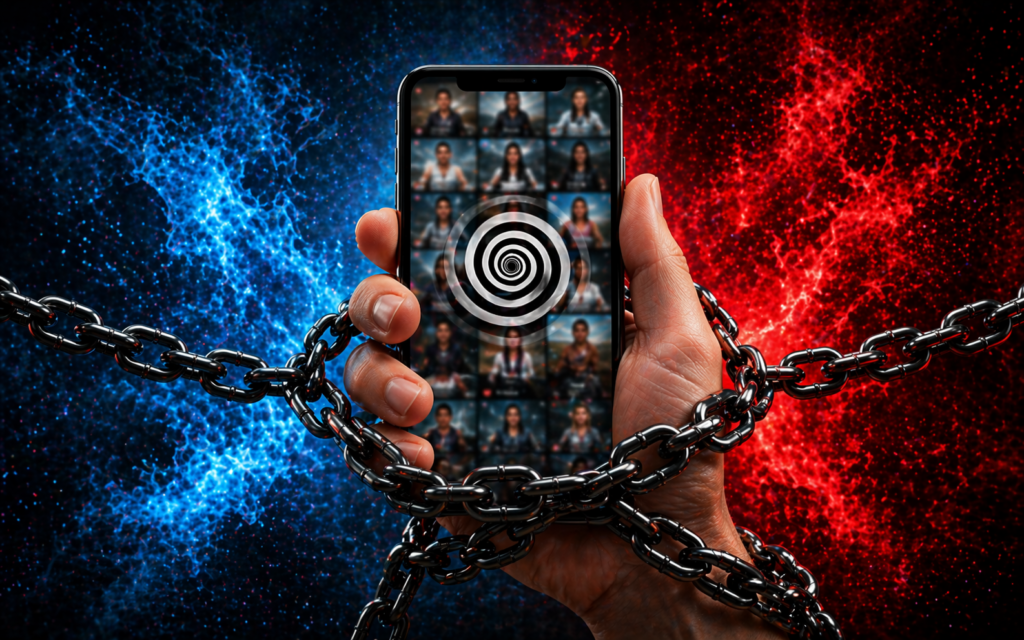
You open Instagram to check a single notification. Within minutes, you are still there—scrolling, tapping, watching. Twenty-seven minutes later, you surface, slightly disoriented, with no clear memory of what you actually consumed. A faint sense of guilt appears, yet you already know you will repeat the same cycle tonight.
This isn’t weakness. It isn’t laziness either. Instead, it is the predictable result of a system designed by highly skilled behavioral scientists. These systems are trained on billions of data points, all optimized for one goal: keeping your attention locked in place.
The scroll is not accidental. The infinite feed is not a convenience. More importantly, autoplay reels, phantom notifications, and red badges are not harmless features. They are carefully engineered triggers designed to capture and hold your focus.
Understanding this system is the first step. Only then can you begin to use it consciously rather than being used by it.
The Slot Machine in Your Pocket
In 2017, Tristan Harris, a former Google design ethicist, made a claim that initially sounded extreme: the smartphone behaves like a slot machine. Over time, this idea has proven accurate—not metaphorically, but mechanically.
Psychologists have long studied variable reward systems. In the 1950s, B.F. Skinner demonstrated that unpredictable rewards create the strongest behavioral conditioning. When a reward appears randomly, subjects don’t just respond—they become obsessed with the possibility of receiving it.
For example, a rat that receives food every time it presses a lever eventually stops pressing. However, when the reward appears unpredictably, the same rat continues pressing endlessly. This is known as a variable ratio reinforcement schedule, and it forms the foundation of slot machine design.
"The feed is not a timeline. It is an algorithmic slot machine that dispenses dopamine hits disguised as content."
— Dr. Anna Lembke, Stanford Psychiatrist & Author, 'Dopamine Nation'
Now compare that to your phone.
Every time you refresh your feed, your brain anticipates a reward. Sometimes the content is boring. Occasionally, it is highly engaging. Because you cannot predict the outcome, your brain stays hooked. That unpredictability is not accidental—it is the core mechanism.
Dopamine plays a critical role here. Contrary to popular belief, dopamine is not about pleasure. Instead, it drives anticipation. It spikes when you expect something rewarding might happen.
As a result, the system keeps you chasing—not satisfying—you.
The Infinite Scroll: A Design Decision with No Off Switch
Before 2006, websites had pages. You reached the bottom, you saw a “Next Page” button, and you had to actively choose to continue. That pause—that tiny moment of friction—was enough for many people to stop and ask, “Do I actually want more?”
Aza Raskin invented the infinite scroll in 2006, and later publicly apologized for it, estimating that it is responsible for roughly 200,000 additional hours of scrolling every day across the internet. The genius, and the horror, of the infinite scroll is this: it eliminates the natural stopping point.
Every psychological nudge toward quitting—the page break, the end-of-content signal—is removed. The content simply continues. Forever. Until you decide to stop. But the human brain, when in a state of passive consumption, is very poor at deciding to stop.
| 2.3 h Average daily time spent on social media globally (2025) | 70% of Instagram Reels viewed are served by the algorithm, not followed accounts | 0.4s Average decision window before a Reel is swiped away—or watched |
In behavioral terms, this is called the default effect. People tend to keep doing what they are already doing—especially when nothing interrupts them.
As a result, scrolling becomes effortless. Stopping, however, requires conscious effort.
The Algorithm Is Not Your Friend—It’s Your Mirror on Steroids

Most users believe the algorithm shows content they enjoy. While that seems true, the deeper reality is more complex.
The algorithm does not prioritize what you like. Instead, it prioritizes what keeps you engaged the longest.
These two things are not the same.
Research has shown that emotionally intense content—such as outrage, anxiety, or desire—keeps people engaged longer than purely positive content. Because of this, the algorithm gradually shifts toward emotionally stimulating material.
Consequently, your feed begins to feel slightly unsettling. It entertains you, but it also activates you. This balance is intentional.
If the content made you completely satisfied, you would stop scrolling. Therefore, the system avoids full satisfaction and instead maintains a loop of partial engagement.
FOMO as a Product Feature
Fear of missing out is not a social media side effect. It is a deliberately cultivated product state. Instagram Stories—with their 24-hour expiry, their real-time location tags, and their “seen by” counters—are an anxiety machine dressed in a friendly interface. The 24-hour countdown creates artificial scarcity of social information. You must check now, or you’ll miss what your social network experienced.
- Phantom notifications—Research shows most heavy smartphone users experience notifications they imagined—the phone vibrated, but didn’t. The platform has conditioned the brain to generate its own alerts, pulling attention back compulsively.
- Activity status indicators—”Active 2 minutes ago.” This feature serves no user benefit. It exists to create social anxiety about response times and to signal reciprocal presence, driving compulsive check-ins.
- View counts on Stories—Knowing who has—and who hasn’t—viewed your Story introduces a social surveillance feedback loop, compelling both poster and viewer into habitual checking behavior.
- Streaks and consistency signals—daily engagement mechanics—follower growth nudges and “your engagement was higher this week” metrics gamify presence, turning social connection into performance maintenance.
- Delayed like notifications—Instagram deliberately batches and delays like notifications, then delivers them in clusters. The delay maximizes the dopamine hit upon opening the app—and trains you to return repeatedly, checking for accumulation.
The Hidden Feedback Loop
Each interaction strengthens the system.
When you engage with certain content, the algorithm learns. It then shows you more of the same. Over time, your feed becomes a reflection—not of your preferences—but of your reactions.
This creates a feedback loop:
- You feel something
- You engage
- The system amplifies it
- You feel it more
Eventually, the loop tightens.
The Identity Trap: When the Feed Becomes Your Self-Concept
Perhaps the most sophisticated layer of the attention economy’s architecture is not the slot machine mechanics or the FOMO engineering — it is the identity integration layer. Instagram is not just a content platform. For hundreds of millions of users, it has become the primary medium through which they construct, broadcast, and validate their sense of self.
Social comparison theory — first articulated by psychologist Leon Festinger in 1954 — describes the human tendency to evaluate our own opinions and abilities by comparing them to others’. We have always done this. But pre-digital social comparison was bounded by reality: you compared yourself to people in your school, your neighborhood, your city. Instagram has dissolved those boundaries entirely.
You now compare yourself daily to a globally curated highlight reel of the most beautiful, most successful, most traveled, most seemingly fulfilled humans on the planet — all of whom are presenting a carefully constructed performance of their best selves. This is not comparison to peers. It is comparison to a fiction, and it is a game the human psyche was never evolved to play.
"Instagram makes girls and women feel worse about themselves and their bodies. This effect is not incidental. It is documented. It is known internally. The product was shipped anyway."
— Summary of leaked Meta internal research, reported by The Wall Street Journal, 2021
The result is a psychological phenomenon researchers now call “upward social comparison spiral.” You see a fitness influencer’s physique and feel inadequate. You feel inadequate, so you seek validation — you post something, you check for likes. The likes provide temporary relief. The algorithm, reading your engagement with that content, serves you more fitness content, more beauty content, more aspirational imagery. The cycle tightens. The gap between who you are and who the feed tells you that you should be widens. You scroll more to manage the feeling. The feeling worsens. You scroll more.
Short-Form Video and the Cognitive Cost No One Talks About
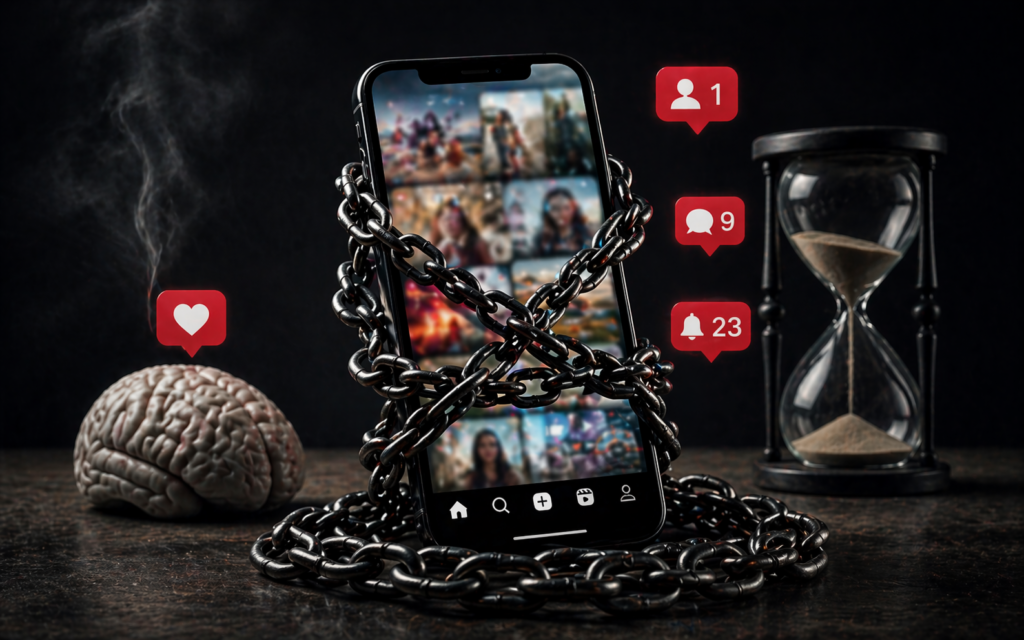
Instagram Reels, TikTok, and YouTube Shorts represent an escalation beyond the original infinite scroll. They are not just endless — they are hyper-stimulating, engineered to the millisecond to capture and hold attention. The average Reel is between 15 and 60 seconds. The average attention window before a user swipes is under two seconds. Every creator making content for this format has learned, through brutal algorithmic feedback, that the first 0.4 seconds must be a hook or the video dies.
What this produces, at scale, is a content ecosystem optimized entirely for maximum stimulus density. Rapid cuts, overlaid text, trending audio, unexpected openings — every Reel is a concentrated packet of sensory information designed to beat the 0.4-second death threshold. When you consume dozens or hundreds of these in a single session, you are subjecting your brain to a level of rapid-stimulus processing that has no precedent in human evolutionary history.
If you’ve noticed your ability to focus declining over time, it’s not random — it’s part of a larger shift explained in our detailed breakdown of attention span crisis caused by AI, where we explore how digital systems are quietly reshaping how we think, process, and concentrate.
Research finding
A 2023 study published in PLOS ONE found that heavy short-form video consumption is correlated with reduced ability to sustain attention on tasks lasting more than two minutes — and that the effect is measurable after as few as three weeks of regular Reels/TikTok use. The brain's default mode network — associated with mind-wandering, creativity, and self-reflection — shows reduced activity in heavy users.
The cognitive tax is real and measurable. Tasks that require deep sustained attention — reading long-form text, writing, studying, holding a complex conversation — become subjectively more effortful and less rewarding when the brain has been repeatedly primed by short-form stimulus. You are not imagining it when you notice that your focus has fractured. You have been training your attention system, thousands of repetitions per day, to expect novelty every 15 seconds. When novelty doesn’t arrive, the system flags the task as unrewarding and generates an impulse to seek stimulation elsewhere. That impulse is the urge to pick up your phone.
The Ethical Architecture Question
It’s worth pausing here to be precise about agency and responsibility. The people who built these systems are not cartoon villains. Many genuinely believed they were building tools for human connection. The problem is structural: in a platform economy monetized by advertising, attention is the product.
More attention equals more revenue. The optimization imperative — maximize time on platform — is not a choice made in a boardroom. It is the inescapable logic of the business model itself.
What changed in the 2010s is that the tools to exploit behavioral psychology at scale became available. Machine learning algorithms that could A/B test every design decision against billions of users, in real time, and select for the version that kept people scrolling longest — that is a qualitatively different capability than anything that existed before. The result is platforms that have, without any single act of malice, evolved toward maximum psychological exploitation through the same blind optimization process that evolution uses to produce predators.
The former president of Facebook, Sean Parker, said in a 2017 interview: “How do we consume as much of your time and conscious attention as possible? The thought process was: how do we give you a little dopamine hit every once in a while? It’s a social-validation feedback loop. You’re exploiting a vulnerability in human psychology.” He called the founders “conscious” of what they were doing. Whether or not that framing is entirely fair, the admission is striking in its directness.
How to Reclaim Your Attention Without Deleting Your Account
Understanding the system doesn’t free you—but it gives you control. The moment you see how it works, you stop being pulled and start choosing. You shift from a passive user to someone who actively decides where attention goes. And that shift changes everything. Here’s what actually works, backed by behavioral research.
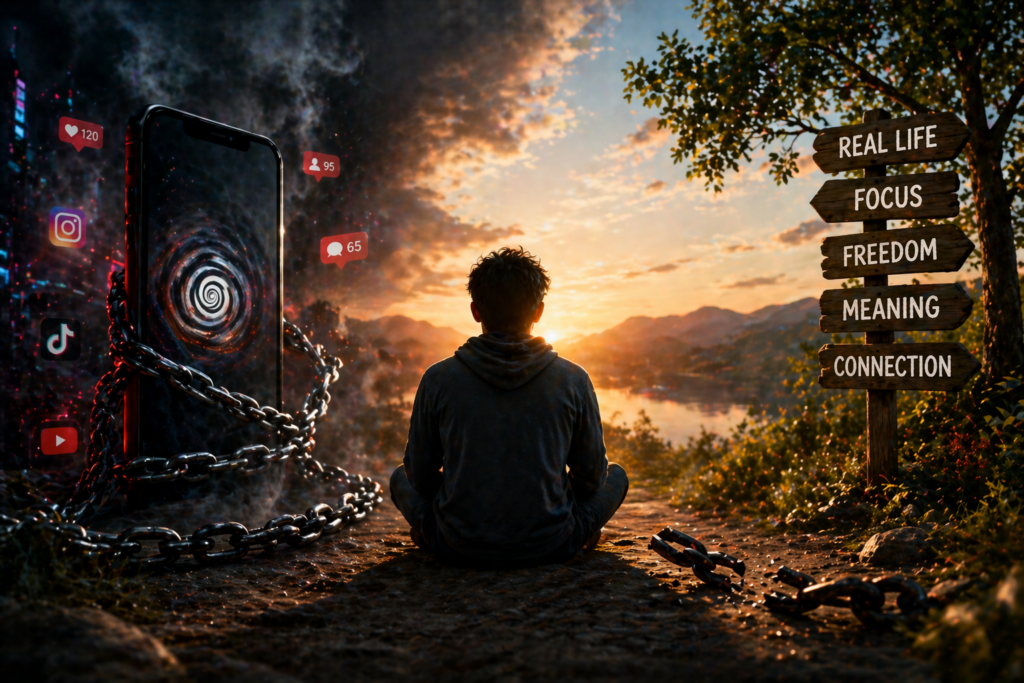
Introduce Friction
Make scrolling less automatic. Log out of apps, move icons away, and turn off unnecessary notifications.
These small barriers create a pause—and that pause helps break the habit.
Set Time Boundaries
Don’t limit minutes, limit timing.
For example: no scrolling before 10 AM or after 9 PM.
It’s easier to follow a rule than constantly control yourself.
Replace, Don’t Restrict
Scrolling usually fills a need—boredom, distraction, or connection.
Instead of forcing yourself to stop, replace it. Keep a book, walk, or do something simple that satisfies the same need.
Train Your Feed
Your feed learns from you.
Skip content that drains you and engage with what adds value. Over time, your feed improves.
Rebuild Focus
Your attention isn’t gone—it’s just trained for quick content.
Start small: read more, stay longer on one task.
Focus comes back with practice.
The scroll is not your fault. But your attention is still yours to reclaim.
One billion people spend an average of over two hours per day in a system designed by the most sophisticated behavioral science ever applied to product design. The fact that it works on you is not evidence of weakness — it is evidence that you are human. The platforms will not change their architecture voluntarily; the incentives point entirely the other direction. Understanding the machinery is not a cure, but it is the only foundation on which genuine agency can be built. Your attention is the most finite and valuable resource you possess. The companies fighting for it know exactly what they're doing. Now, so do you.
Frequently Asked Questions
Why is scrolling on Instagram so addictive
Scrolling is addictive because platforms use variable rewards, dopamine triggers, and infinite scroll to keep users engaged without natural stopping points.
Infinite scroll removes decision pauses, making your brain continue consuming content automatically due to the default behavior effect.
Algorithms prioritize emotionally engaging content like curiosity, anxiety, and excitement, which increases watch time and keeps you scrolling longer.
Yes, heavy scrolling—especially short-form videos—can reduce focus and make it harder to engage in deep thinking or long tasks.
You can reduce scrolling by adding friction (logging out), setting time boundaries, and replacing scrolling with meaningful activities

Hey, I’m Vishal Srivastava — the person behind USAConcern.com. I started this site because I genuinely believe there are conversations happening in America that deserve more honest, human coverage. I write about health, mental wellness, lifestyle, and the cultural shifts shaping everyday American life, as I come from a strong background in artificial intelligence and engineering, combined with certified knowledge in mental wellness and fitness. My goal is to bridge the gap between technology and human well-being. I believe true success comes from a balance of a sharp mind, a healthy body, and smart use of technology. Through my work, I aim to provide practical solutions that improve both performance and lifestyle. Thanks for reading—your journey to a better mind, body, and life starts here.
Keep up the great work.
Very informative and easy to understand.