
Artificial Intelligence (AI) has rapidly transformed from a futuristic concept into a cornerstone of modern technology, reshaping how we live, work, and interact with the world.
Introduction to Artificial Intelligence
At its core, AI is a field of computer science dedicated to creating systems capable of performing tasks that typically require human intelligence. These tasks include problem-solving, pattern recognition, understanding natural language, and autonomous decision-making.
Unlike traditional software that follows rigid, pre-programmed rules, modern AI—powered by Machine Learning (ML) and Deep Learning—learns from vast amounts of data to improve its performance over time.
The Current Landscape of AI
Today, AI is integrated into almost every industry:
- Generative AI: Tools like LLMs (Large Language Models) are revolutionizing content creation, coding, and creative arts.
- Healthcare: AI algorithms assist in early disease detection, drug discovery, and personalized treatment plans.
- Finance: Systems use AI for high-frequency trading, fraud detection, and credit scoring.
- Transportation: Autonomous vehicles and smart traffic management systems are becoming increasingly sophisticated.
The Future of AI: What Lies Ahead?
The future of AI is expected to move beyond specialized “Narrow AI” toward more integrated and autonomous systems.
- Human-AI Collaboration: The focus is shifting from AI replacing humans to AI acting as a “Co-pilot.” This synergy will likely enhance human productivity in scientific research, engineering, and education.
- Edge AI: Instead of relying on massive cloud servers, AI will increasingly run directly on local devices (phones, appliances, industrial sensors), leading to faster processing and better privacy.
- Sustainable AI: As the energy demands of training large models grow, the future will prioritize “Green AI”—algorithms designed to be computationally efficient and environmentally sustainable.
- Advancements in Robotics: AI will provide the “brain” for more agile and intuitive robots capable of assisting in elderly care, disaster recovery, and complex manufacturing.
Ethical Considerations and Challenges
As AI becomes more powerful, addressing its challenges is crucial for a positive future:
- Bias and Fairness: Ensuring that AI models do not perpetuate human prejudices found in training data.
- Transparency (Explainable AI): Developing systems where the decision-making process is understandable to humans, especially in legal or medical contexts.
- Job Displacement: Navigating the economic shift as certain roles become automated, necessitating widespread reskilling.
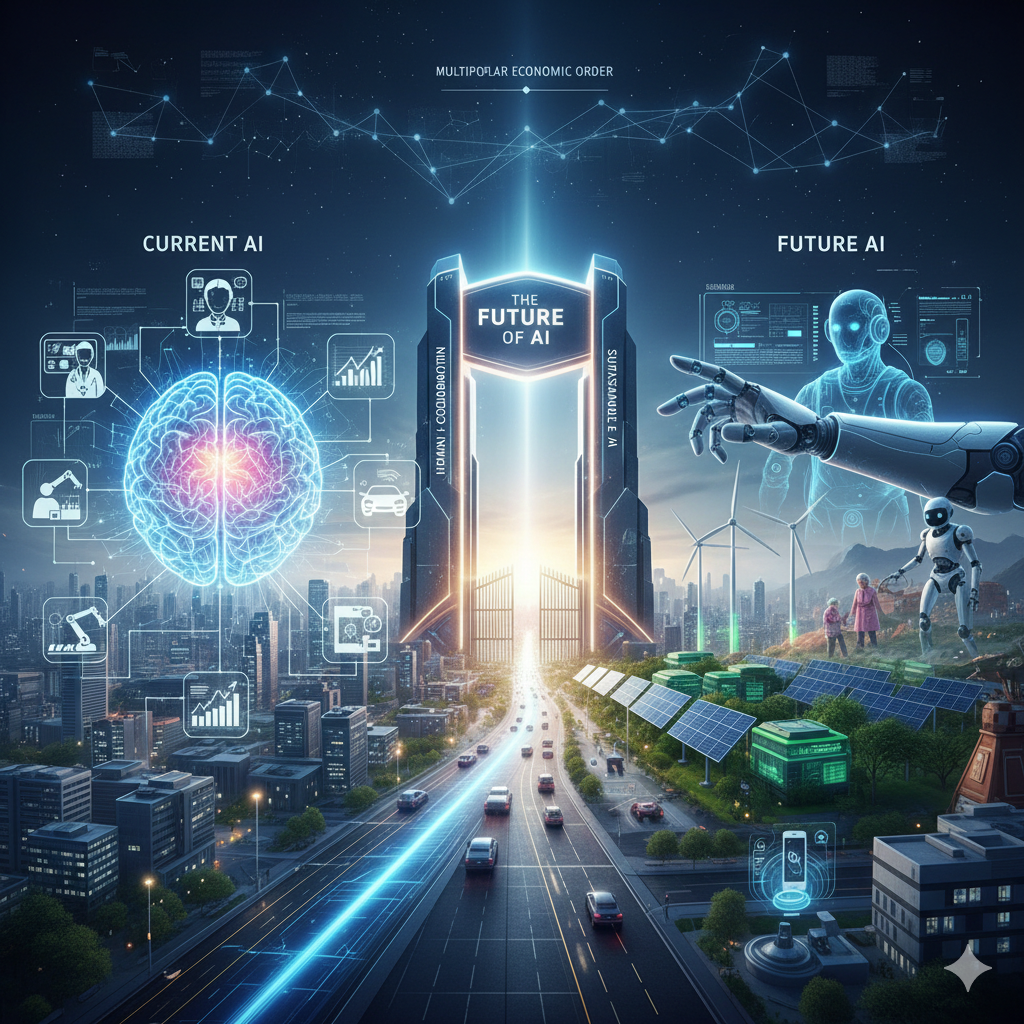
Building on your exploration of AI’s future, the following “5 Trends” emerge as the primary forces set to reshape the global landscape over the next decade.
The 5 Trends Transforming the Future of AI
- Agentic AI and Autonomous Systems: AI is shifting from a passive “copilot” to active “agents.” These systems can plan, reason, and execute multi-step business workflows (like HR onboarding or supply chain management) with minimal human oversight.
- Multimodal Ubiquity: Future AI won’t just process text; it will perceive the world holistically. Models are integrating voice, vision, and video in real-time, allowing AI to “see” context and “hear” emotion, leading to more natural human-machine interactions.
- Physical and Embodied AI: AI is gaining a “body” through advancements in robotics and “Cobots” (collaborative robots). This trend is moving intelligence from the screen into the real world, powering precision assembly in manufacturing and autonomous equipment in agriculture.
- Edge Intelligence (On-Device AI): To solve privacy and latency issues, AI is moving from massive data centers to local devices. “Small Language Models” (SLMs) will allow your smartphone, car, or industrial sensor to run powerful AI locally without needing a constant cloud connection.
- Generative UI (GenUI): Interfaces are becoming dynamic. Instead of a static app design, AI will generate personalized user interfaces in real-time based on your specific intent, creating software that literally redesigns itself to help you complete a task.
Impact Summary: 2026 and Beyond
| Trend | Business Impact | Primary Industry |
| Agentic AI | 40% average reduction in operational costs. | Finance, Logistics, HR |
| Physical AI | 125% growth in robotics technician roles. | Manufacturing, Construction |
| Edge AI | Enhanced data privacy and zero-latency response. | Healthcare, IoT, Mobile |
| GenUI | 20-30% uplift in user conversion rates. | E-Commerce, SaaS |
To visualize the complex world of Artificial Intelligence, it is best to view it as a hierarchical ecosystem that moves from broad concepts to specific, high-impact future trends.
The AI Hierarchy: From Foundation to Application
The following structure illustrates how AI is organized, showing the relationship between its core subfields and the specific techniques used to power them.
Code snippet
graph TD
    A[ARTIFICIAL INTELLIGENCE] --> B[Machine Learning -ML-]
    A --> C[Natural Language Processing -NLP-]
    A --> D[Computer Vision]
    A --> E[Robotics & Automation]

    B --> B1[Supervised Learning]
    B --> B2[Unsupervised Learning]
    B --> B3[Reinforcement Learning]
    B --> B4[Deep Learning]

    B4 --> B4a[Neural Networks]
    B4 --> B4b[Generative AI / LLMs]

    C --> C1[Text Analysis]
    C --> C2[Speech Recognition]
    C --> C3[Translation]

    D --> D1[Image Recognition]
    D --> D2[Object Detection]
    D --> D3[Facial Recognition]
The Architectural Stack: How AI Systems Work
Modern AI is not just a single algorithm; it is a “stack” of layers that work in concert to process information.
| Layer | Component | Function |
| 1. Infrastructure | GPUs, TPUs, Cloud (AWS/Azure) | The raw “compute” power required to train and run models. |
| 2. Data Layer | Ingestion, Cleaning, Storage | The “fuel” for AI; handles structured and unstructured data. |
| 3. Modeling Layer | Algorithms (Transformers, CNNs) | The “brain” where learning and pattern recognition occur. |
| 4. Deployment (Ops) | MLOps, APIs, Monitoring | The “delivery” system that brings AI into apps and tools. |
| 5. Interface | Chatbots, Dashboards, Voice | The “user interaction” layer where people use the AI. |
Future Trends: The Shift to 2030
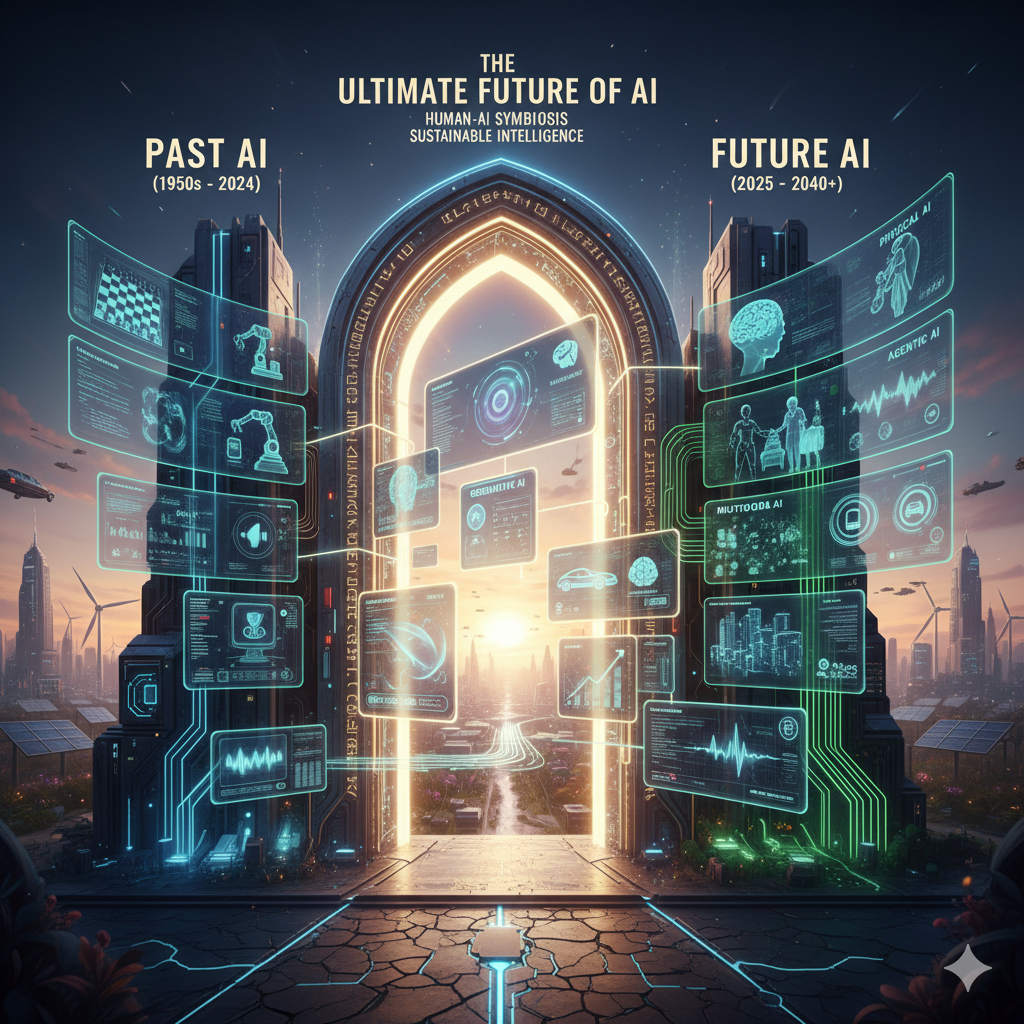
As we move toward the next decade, the “Future AI” segment of the chart is expanding into three specialized areas:
- Agentic AI: Systems that don’t just answer questions but autonomously execute multi-step workflows (e.g., booking travel or managing an entire supply chain).
- Multimodal Native: Models that understand text, audio, and video simultaneously in a single “brain,” making them far more human-like in perception.
- Edge AI: Moving intelligence away from massive data centers and directly onto your phone or car for instant, private processing.
This structured view helps in understanding that while Generative AI (like LLMs) is the most visible part today, it is only one branch of a much larger technical and strategic tree.
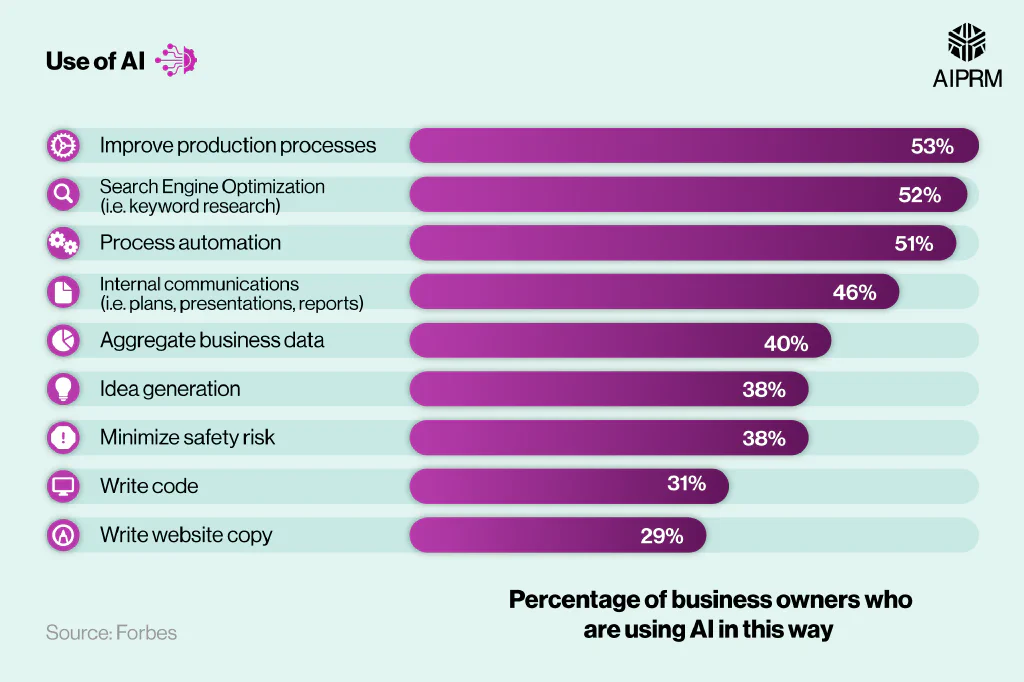
This roadmap is designed for professionals whose roles are most impacted by Generative AI—such as software developers, content creators, data analysts, and administrative staff. Looking at the 2026 landscape, it is no longer just about “learning” AI, but about “co-piloting” or collaborating with it.
Generative AI Reskilling Roadmap (2026 Edition)
Phase 1: Foundation & AI Literacy (Weeks 1–4)
- Core Concepts: Understanding how LLMs (Large Language Models) and Diffusion Models function.
- Prompt Engineering Mastery: Learning advanced techniques like ‘Chain-of-Thought’ and ‘Few-shot prompting.’
- Ethical AI & Bias: Identifying the reliability of AI-generated data and recognizing inherent biases.
Phase 2: Role-Specific Integration (Weeks 5–12)
| Impacted Area | Key Skills | Tools & Technology |
| Creative & Content | AI-Augmented Editing & Strategy | Midjourney v7, Runway, AI-assisted Storyboarding |
| Coding & Tech | AI Code Review & System Architecture | GitHub Copilot Next, AI-driven Debugging |
| Data & Analysis | Automated Insight Generation | Agentic Data Workflows, Natural Language Querying |
| Admin & Ops | Workflow Automation (Agentic AI) | Zapier Central, Microsoft 365 Copilot |
Phase 3: Strategic Leadership & Soft Skills (Ongoing)
- Human-in-the-Loop (HITL): The ability to verify, validate, and refine AI outputs.
- Critical Thinking: Identifying high-complexity problems that AI cannot solve independently.
- Emotional Intelligence: Focusing on client management and team leadership where the human touch is mandatory.
Learning Curriculum: Module Structure
- Module 1: The Generative Era – The fundamental shift from traditional software to generative models.
- Module 2: Advanced Prompting – Mastering multi-step prompting for complex professional tasks.
- Module 3: AI Toolstack Deep Dive – Hands-on practice with the top 5 tools specific to your field.
- Module 4: Security & Compliance – Protecting corporate and sensitive data while using AI tools.
- Module 5: Future-Proofing Strategy – Developing habits for continuous learning in an accelerating tech environment.
In conclusion, the evolution of Artificial Intelligence toward 2030 marks a shift from AI as a tool to AI as a partner. By 2026, the experimentation phase has ended, and the focus has moved to Agentic Systems that act independently and Multimodal Models that perceive the world as humans do.
Ultimately, the future of AI is defined by Synergy and Sovereignty: the successful integration of autonomous intelligence into the physical world (Robotics) and the transition to efficient, localized processing (Edge AI). Organizations and individuals who move beyond simple prompt-based interaction and master the orchestration of these complex systems will lead the next era of digital transformation.
Summary of the Final Shift
- From Reactive to Proactive: Agents don’t just answer; they execute multi-step workflows.
- From Cloud-Heavy to Hybrid: Intelligence is distributed between massive data centers and local Edge devices.
- From Expertise to Orchestration: The most valuable skill is no longer just “using AI,” but managing a network of specialized AI agents.