
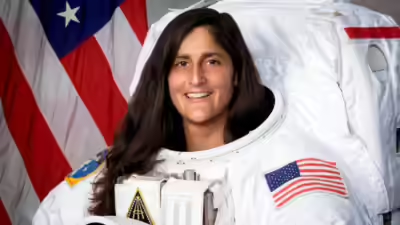
Sunita Williams is a world-renowned American astronaut of Indian and Slovenian descent, celebrated for her trailblazing career in space exploration and her leadership as a Navy pilot.
Here is a summary of her extraordinary journey and achievements:
Early Life and Foundations
Born in 1965 in Ohio and raised in Massachusetts, Williams grew up in a multicultural, intellectual household. Her father, a neuroanatomist from Gujarat, India, and her mother, of Slovenian heritage, encouraged her curiosity and independence. Though she was a competitive swimmer and athlete, her path to space wasn’t immediate; she initially focused on her love for aviation and technology.
Military and Academic Excellence
- Naval Career: After graduating from the U.S. Naval Academy in 1987, she became a decorated Navy helicopter pilot, flying missions during Operation Desert Shield/Storm.
- Education: She holds a Master’s degree in Engineering Management (1995), which bridged her pilot experience with technical expertise.
NASA Career and Record-Breaking Missions
Selected by NASA in 1998, Williams has spent her career pushing the boundaries of human endurance:
- First Mission (2006): Set records for the longest spaceflight by a woman (at the time) and total spacewalk duration.
- Second Mission (2012): Made history as the second woman to ever command the International Space Station (ISS).
- Current Mission (2024–2025): Launched aboard the Boeing Starliner in June 2024. Due to technical issues, her mission was extended, and she assumed command of the ISS for a second time in September 2024. She is scheduled to return to Earth in February 2025.
Legacy and Inspiration
With over 50 hours of total spacewalk time, Sunita Williams is one of the most experienced astronauts in history. Beyond her technical feats, she is a global icon for STEM education, particularly for women and people of diverse backgrounds. She remains deeply connected to her Indian and Slovenian roots, viewing the ISS not just as a laboratory, but as her “happy place.”
Key Statistics
- Total Spacewalks: 7 (over 50 hours total)
- Command Roles: Two-time Commander of the ISS
- Current Status: Currently aboard the ISS (at ag
Certainly! Following her recent retirement on December 27, 2025, after a legendary 27-year career, here is a detailed breakdown of her space missions and the honors she has received.
Space Mission Timeline
Sunita Williams has spent a total of 608 days in space, ranking her second among all NASA astronauts for cumulative time in orbit.
| Mission / Expedition | Dates | Key Achievements & Roles |
| Expedition 14/15 | Dec 9, 2006 – June 22, 2007 | Served as Flight Engineer. Performed 4 spacewalks and became the first person to run a marathon in space. |
| Expedition 32/33 | July 14, 2012 – Nov 18, 2012 | Served as Flight Engineer (Exp. 32) and Commander (Exp. 33). Completed a triathlon in orbit using specialized exercise equipment. |
| Boeing Starliner / Crew-9 | June 5, 2024 – March 18, 2025 | Pilot for Boeing’s Crew Flight Test. Mission extended due to technical issues; she served as Commander of Expedition 72. |
Major Awards and Honors
Williams has been recognized globally for her military service, technical expertise, and contributions to space science.
Civilian & International Honors
- Padma Bhushan (2008): India’s third-highest civilian award, given for her contributions to Science and Engineering.
- Sardar Vallabhbhai Patel Vishwa Pratibha Award: Awarded by the World Gujarati Society.
- Medal “For Merit in Space Exploration” (Russia): Awarded by the Russian government for her work on the ISS.
- Golden Order for Services (Slovenia): Recognition of her Slovenian heritage and achievements.
Military & NASA Decorations
- Defense Superior Service Medal (2): For high-level leadership and service in the U.S. Navy.
- Legion of Merit: Recognizing exceptionally meritorious conduct in the performance of outstanding services.
- NASA Space Flight Medal: Awarded for her successful orbital missions.
- NASA Distinguished Service Medal: The highest award conferred by NASA.
- Navy Commendation Medal (2) & Navy Achievement Medal: For her service as a Naval Aviator and test pilot.
- Humanitarian Service Medal: For her work in disaster relief operations, including Hurricane Andrew.
Records at a Glance
- Total Spacewalks: 9
- Cumulative Spacewalk Time: 62 hours, 6 minutes (The most by any woman in history).
- Total Time in Space: 608 days.
- Single Longest Mission: 286 days (during her final 2024–2025 mission).
Sunita Williams officially retired from NASA on December 27, 2025, concluding a legendary 27-year career. Her final mission, which began as an 8-day test flight, became a historic 286-day stay that showcased her resilience and leadership.
Final Mission: Boeing Starliner & Expedition 72
Her final stint in space (June 2024 – March 2025) was one of the most complex in ISS history. While technical issues with the Starliner capsule delayed her return, she used the extra time to lead critical station operations.
Key Experiments & Scientific Work
During Expedition 72, Williams focused on cutting-edge research to help future Moon and Mars missions:
- Microbial DNA Sequencing: She worked on the GISMOS project, sequencing DNA from the station’s water system to monitor microbial health in real-time.
- Metal 3D Printing: She helped operate a new metal 3D printer (an ESA project) to test how parts can be manufactured in microgravity, a necessity for long-term lunar bases.
- Plant Biology: She managed investigations into “Antarctic moss” to see how plants survive the combined stress of cosmic radiation and microgravity.
- Spacewalk Maintenance: She performed two additional spacewalks during this final mission. On January 16, 2025, she and Nick Hague repaired an orientation control assembly and patched filters for the NICER X-ray telescope.
Retirement and Future Outlook
Sunita Williams’ retirement marks the transition from the “Shuttle-ISS Era” to the “Artemis Era.”
- Career Stats: She retired with 608 total days in space (the second-highest for any NASA astronaut) and 62 hours, 6 minutes of spacewalking time (the world record for a woman).
- Post-NASA Activities: Since retiring in late 2025, she has been active in international outreach. In January 2026, she visited India, speaking at the American Center in New Delhi and attending the Kerala Literature Festival.
- Legacy: NASA Administrator Jared Isaacman described her as a “trailblazer” whose work on commercial crew testing (Starliner) and the ISS laid the groundwork for humans returning to the Moon.
Summary Table: The Final Chapter
| Event | Date | Details |
| Launch | June 5, 2024 | Aboard Boeing Starliner (Crew Flight Test). |
| Command | Sept 23, 2024 | Assumed Command of the ISS (Expedition 72). |
| Return | March 18, 2025 | Returned via SpaceX Dragon (Crew-9) after 286 days. |
| Retirement | Dec 27, 2025 | Officially left the NASA Astronaut Corps. |
In conclusion, Sunita Williams’ career is a remarkable narrative of human resilience, transitioning from a Navy helicopter pilot to one of the most decorated figures in the history of space exploration. Her journey reached its professional zenith in December 2025, when she officially retired from NASA after 27 years of service.
The final chapter of her spaceflight career was perhaps her most testing; what was intended to be an eight-day test flight of the Boeing Starliner in 2024 evolved into a 286-day odyssey. Rather than viewing the delay as a setback, Williams embraced her role as Commander of the ISS for a second time, overseeing critical maintenance and pioneering scientific research in DNA sequencing and 3D metal printing.
Today, as a retired U.S. Navy Captain and NASA legend, her legacy is defined by staggering milestones:
- 608 total days in space, ranking her second among all NASA astronauts.
- 62 hours and 6 minutes of cumulative spacewalk time—the world record for a woman.
- A global inspiration for the STEM community, bridging cultures from Ohio to Gujarat to Slovenia.
Even in retirement, she remains a “trailblazer” in every sense. As of January 2026, she is actively sharing her story with the next generation, recently visiting IIT Delhi and the Kerala Literature Festival to remind us that “boundaries feel meaningless” when looking at Earth from above. Her life stands as a testament to the fact that with curiosity and teamwork, the sky is never the limit—it is only the beginning.