
American Travel 2026 tells two stories. Ask the industry — everything looks booming. Ask the 60% of Americans who never left this country, the families in vacation debt, or the middle class priced out of trips they once took for granted — and you hear something very different. This is the investigation that names what the industry won’t..
This is the investigation that bridges those two realities—with hard data, honest analysis, and the solutions Washington and the travel industry refuse to discuss.
| $6,556 Record leisure budget 2026 | 60% have never traveled internationally | $33BAirline fees—2025 record | 14.9% airfare rise year-over-year | $12.5B lost foreign visitor spending | 29% Drop in European US bookings |
American Travel 2026: The Statistic That Changes Everything
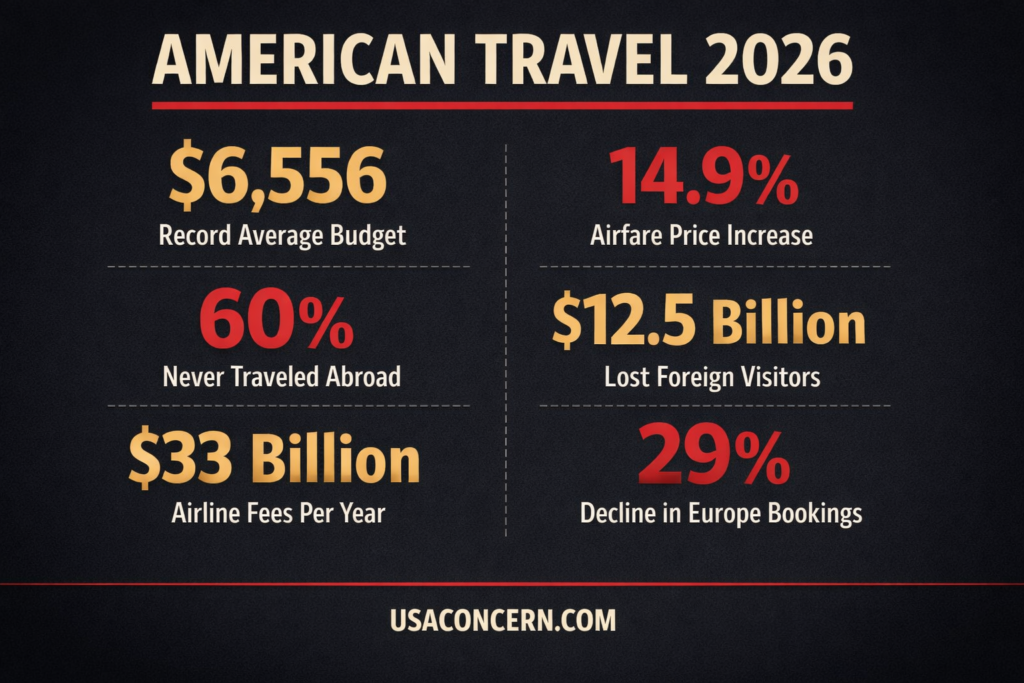
Three out of five Americans have never experienced another country firsthand. Every trend report describes a traveler who is global-minded and flush with cash. Nothing in that portrait matches the majority of this country. That disconnect is the starting point for this investigation.
Travel journalism carries a structural bias. The journalists who cover this industry travel frequently. It creates a profound blind spot about average Americans. What gets celebrated as a travel boom is a boom for a specific demographic only.
Why the 60% Figure Changes Everything
Our analytical mandate runs differently from sponsored travel coverage. The data we examine is unglamorous but essential. Our readers span every income bracket and every zip code. Consider what structural inaccessibility actually looks like in practice.
Add the $165 adult passport fee to a realistic airline budget. Each year, baggage fees climb higher. Result: the gap between advertised and real travel costs widens every quarter. That gap falls hardest on families with the least financial cushion.
I want to state my position clearly. The travel industry’s storytelling is not neutral journalism. It is marketing dressed as analysis. Every record-budget headline that omits the 60% who never leave is a headline that has chosen whose reality to center.
At USAConcern, we choose differently. American travel in 2026 is not a success story for most Americans. Understanding why requires looking at the data the industry buries — and naming the failures responsible for creating them.
April 2026 Data: Travel Prices Hit Their Biggest Spike in Three Years
Here is the data every travel publication should lead with. Airfare costs jumped 14.9% over the past year. Dining out costs rose 3.8% year-over-year. Each of these increases compounds on already elevated post-pandemic prices.
Overall travel prices rose 7% versus March 2025. That is the highest year-over-year jump since March 2023. Rental car prices added another 8.1% year-over-year. Together, these costs destroy the budgets of families watching every dollar.
The Budget Numbers Hide More Than They Reveal
Planned average spending of $6,556 sounds like strong confidence. Yet 61% of Americans simultaneously say they cannot afford to travel more. Moreover, 27% changed destinations specifically because of flight prices. Meanwhile, 27% decided not to travel at all — solely because of airline fees.
Revenge travel is officially dead. That declaration came from Chris Carnicelli, CEO of Generali Global Assistance. According to Forbes, he called it “officially dead” in 2026. Travelers now ask one question before booking: “Why am I going?”
| 14.9% Airfare up YOY—April 2026. Highest annual airfare increase in three years. Bureau of Labor Statistics CPI data, April 2026 | 7% total travel price rise Overall travel costs up 7% versus March 2025 — the biggest spike since March 2023. NerdWallet Travel Price Index. | 20% Above Pre-Pandemic Costs: March 2026 travel costs sit 20% above March 2019 levels, even as general inflation ran at 29.9%. | 50.5% restaurant price rise—10 yrs Dining out costs 50.5% more than a decade ago — outpacing overall inflation and destroying vacation meal budgets. |
What the IPX1031 Survey Tells Us About Real American Budgets
Nearly 1 in 5 Americans say they would go into debt for a vacation. That figure comes from IPX1031’s 2026 survey of 1,000 U.S. adults. Buy-now-pay-later services now fund 15% of American travel expenses. Among debt-takers, the average amount borrowed is $2,525.
The $33 Billion Airline Fee Machine — and Who Really Pays

Airlines collected approximately $33 billion in ancillary fees in 2025. That is the largest annual fee haul in industry history. Every major carrier participated in this extraction. This is not market friction — it is deliberate architecture.
How the Booking Platform Deceives You
Booking platforms rank airlines by base fare only. By the time you reach the fee screens, you feel committed to the trip. Carriers exploit that moment. The result, a family of four often pays $300–$500 more than the search engine showed.
In April 2026, American Airlines raised its first checked bag fee to $50. All five major carriers implemented increases within weeks of each other. American, Delta, United, JetBlue, and Southwest all acted within a fortnight. Five simultaneous increases that fast raise serious competitive questions.
The Real Cost Gap — American Travel 2026
A family of four in Basic Economy, checking two bags each way and selecting seats: add $400–$600 to the advertised fare before boarding. That $299 round-trip? Realistically $550+ per person at the gate.
The Biden administration’s junk fee transparency rules are under review. Enforcement has already weakened. Always calculate the full all-in cost before committing to any booking.
Why Neither Party Has Fixed This
Airlines lobby aggressively against fee disclosure requirements. Regulatory changes get quietly weakened after they pass. Both parties in Washington have historically prioritized airline lobbying over passenger protection. Consumers absorbing the greatest burden are Basic Economy passengers — the most financially vulnerable travelers.
My analysis is direct. The airline industry has made the unbundled fee model permanent. No major carrier that adopted it has ever reversed course voluntarily.
This is not a market functioning efficiently. It is a captured market — one where lobbying has neutralized consumer protection while maintaining the illusion of competition through low advertised base fares.
The K-Shaped Collapse of Middle-Class American Travel in 2026
Economists call it the K-shaped economy. This means upper-income households grow while middle and lower-income households stagnate. Resonance Consultancy projects the top 10% will spend $544 billion on leisure travel in 2026. High-income travelers average 5.2 leisure trips per year. Everyone else averages 4.0.
The Middle-Class Squeeze in Real Numbers
Casey Halloran runs Costa Rican Vacations. His summary was precise: “The middle-class traveler to Costa Rica has all but vanished.” Las Vegas recorded its largest visitor drop in fifty years in 2025. Brookings Institution confirms the backdrop: one-third of middle-class families cannot afford basic necessities.
National park visitation exceeded 331 million visits in 2024 — the highest ever recorded. These are not travelers choosing parks over Paris for aesthetic reasons. Domestic alternatives have become the only financially viable option for many families. For many households, the annual vacation migrated from resort to campsite.
Sarah and Marcus live in Columbus, Ohio. Combined, they earn $118,000 a year. After rent, car payments, health insurance, and childcare, roughly $1,400 remains each month for everything else.
Their last real family vacation was 2019. This spring, they committed to Florida. The search engine showed $274 round-trip fares. After bags and seat selection for four people, airfare alone hit $1,880. The hotel added a $31-per-night resort fee. Theme park tickets had risen again.
Final total: $6,100. At 22.9% APR, carried six months, that trip costs $6,900 before the balance clears. The memories will last. The debt will too.

Why the K-Shape Is Not an Accident
Federal Reserve data shows the top 1% held nearly 32% of all national wealth in Q3 2025. The net worth of the bottom 50% stood at just 2.5%. Moody’s chief economist Mark Zandi called this “structural” — not temporary. Travel inequality is economic inequality made visible at the departure gate.
My position is unambiguous. The disappearance of affordable leisure travel for middle-income families is not a natural market outcome. It results from specific, identifiable decisions.
Airline unbundling. Hotel resort-fee proliferation. The systematic removal of pricing transparency rules. Each one is a deliberate choice. When a family earning $118,000 goes into debt to take their children to see a beach, something fundamental has broken in the American promise to people who work hard and play by the rules.
How Americans Are Adapting Their Travel Habits in 2026
How Americans Are Adapting Their Travel Habits in 2026
Despite financial pressure, Americans have not abandoned travel. Specifically, the defining shift is what Hilton calls the “Whycation.” Rather than starting with a destination, travelers now start with an intention. The destination becomes the setting — not the point.
Slow Travel Is Now Mainstream
Future Partners’ February 2026 research found a clear shift. More than 52% of Americans stayed in one place rather than hopping between destinations. Furthermore, half say they actively immerse themselves in local culture on trips. Gen Z travelers embrace single-destination slow travel most strongly at 67.2%.
Beach.com’s survey of 1,000+ adults asked Americans to rate travel trends. AI travel tools topped the most-overrated list for the second year running. What ranked as the most underrated trend? Family-oriented getaways — followed immediately by domestic road trips.
What Americans Actually Want From Travel in 2026
Hilton’s 2026 Trends Report is direct on this point. Rest and recharge are now the top motivations for leisure travel. Nearly half of travelers add solo days before or after family trips. Over half say they would take a work trip just to get quiet time alone.
Key Behavioral Data — American Travel 2026
- 71% of summer travelers cite relaxation and stress relief as their primary motivation — not novelty or adventure (Future Partners, March 2026)
- 76% of Americans now plan trips around major life milestones rather than destinations — AAA / Bread Financial 2026
- 80% of global travelers plan to take the same or more international trips in 2026 — but only among those earning $50K+ equivalent (Amex Travel / Morning Consult)
- 64% of Millennials and Gen Z would accept a job with fewer benefits if it offered more travel flexibility — American Express Travel 2026 Report
- Personal recommendations from friends and family rank as the #1 travel information source — above all social media, publications, and AI tools (Going.com 2026)
- 331 million national park visits in 2024 — the highest on record — as American families rediscover domestic geography over expensive international options
The Amex Travel Report Shows a Milestone Shift
American Express Travel’s 2026 Global Trends Report confirms the pivot. Their research covered 7 countries and over 7,000 respondents. 84% of Millennials and Gen Z say milestone trips free them to explore new destinations. Two-thirds plan a milestone trip for someone else in 2026.
Where to Go: The Honest American Travel Guide for 2026

Destination intelligence matters more in 2026 than ever before. Specifically, geopolitics, currency dynamics, and value-for-money have all become essential planning inputs. Geopolitical complexity alone has rerouted billions in American travel spending. The following assessments come from research — not press-trip relationships or paid partnerships.
Southeast Asia: The Clear Value Champion
Vietnam leads every honest value ranking for American travel in 2026. Hanoi’s Old Quarter at dawn, Hoi An’s lantern rivers, and Halong Bay’s karst geography each deliver extraordinary depth. South Korea arrives at its cultural peak this year. Seoul’s neighborhoods reward slow, deliberate exploration.
The KTX high-speed rail connects South Korea’s entire country in hours. Travel advisors consistently call it the most navigable destination in Asia for Americans. Japan remains the gold standard for experienced travelers. Shikoku, Tottori, and Tohoku offer Japan’s depth at a fraction of the crowd pressure.
Latin America and the Coolcation Surge
Peru stands as the strongest full-spectrum destination in the Western Hemisphere. Lima has reached genuine world food capital status. Guatemala offers Lake Atitlan’s volcanic drama at costs that shame European alternatives. For the traveler watching their budget, it is a serious analytical choice — not compromise.
Scandinavia travel is growing as much as 35% in 2026. Norway, Iceland, Sweden, and Finland all benefit from rising coolcation demand. Iceland and Alaska offer extreme natural drama with straightforward access. All four destinations carry strong safety reputations — a meaningful factor in 2026’s geopolitical climate.
For current State Department travel advisories, visit travel.state.gov. Enroll in the free STEP notification program at step.state.gov before any international trip.
Where Americans Avoid Traveling — Geopolitics Drives Every Decision in 2026
American travel choices in 2026 cannot be separated from geopolitics. Travelers make active, rational calculations about safety and value. Decisions now factor in political tensions, visa complexity, and currency disadvantage. Consequently, the global travel map looks fundamentally different than it did in 2019.
| Destination | Core Issue for American Travelers | 2026 Status |
|---|---|---|
| United Kingdom | Pound strength punishes dollar-spending Americans daily. Political turbulence adds ambient unease. Terrorism advisories remain active. | Declining bookings |
| France & Germany | Political instability, visible security presence, and a value equation American travelers increasingly reject against Asia and Latin America alternatives. | Softening demand |
| China | US-China tensions, strict visa requirements, mandatory internet censorship, and pervasive surveillance have made China functionally hostile to casual American visitors in 2026. | Sharp decline |
| Russia | State Dept. Level 4 “Do Not Travel.” Active conflict. Commercial flights restricted. Effectively inaccessible for American tourists. | Effectively closed |
| Israel | Extended regional conflict, US carrier route adjustments, safety unpredictability, and ethical concerns across the political spectrum all suppress demand. | Severely disrupted |
| Vietnam / South Korea / Japan | Strong safety perception, honest value, no significant advisories, deep cultural appeal across all American demographic groups. | Rising strongly |
| Peru / Guatemala / Colombia | Food tourism surge, world-class natural and archaeological experiences, improving infrastructure, and genuine pricing transparency. | Rising strongly |
The China Question Americans Need to Confront
China represents something unique in 2026. Tour operators who once featured China as a flagship product now steer clients toward Japan and South Korea instead. Some paused China offerings entirely for the 2026 season. Cultural estrangement between America and China serves nobody’s long-term interest.
The avoidance pattern is analytically clear. Americans are not becoming less curious. They make rational calculations and route around destinations where the analysis fails.
When ordinary Americans cannot visit the world’s most populous civilization — and ordinary Chinese citizens face hostile barriers to visiting us — we lose the only reliable antidote to mutual demonization: direct human contact at scale. That consequence belongs in the national security conversation, not just in the travel section.
Washington Killed American Tourism From the Outside In — Here Is the Evidence
While Americans travel outward in record numbers, the world has stopped coming here. The World Travel and Tourism Council projects a $12.5 billion loss in international visitor spending in 2026. Furthermore, summer 2026 bookings to the U.S. from Europe dropped more than 29%. Bookings from December 2025 showed only 3.2 million overseas arrivals — 8% below the pre-pandemic low.
The Specific Declines Washington Created
Western Europe declined across every major market. France fell 5.9%. As of January 1, 2026, citizens of 39 countries face complete entry bans or severely harder visa procedures. These are the most sweeping U.S. entry restrictions in recent decades.
Canada’s collapse deserves specific attention. Trump administration statements about annexation shifted Canadian public opinion sharply against U.S. travel. CoStar’s Jan Freitag told WTOP that visa and immigration policies created “a chilling effect on international inbound.” Foreign visitors spend two to three times more per day than domestic tourists.
“Five years ago the United States was the default dream destination. Today many clients simply say: there are easier and friendlier ways to spend two weeks of vacation.”— European Tour Operator, quoted in Tourism Review, late 2025
Why This Hurts Working Americans — Not Just Tourism Boards
New York City and Los Angeles depend heavily on international visitors. Los Angeles specifically loses premium spending when foreign tourists stay home. Hotel workers, restaurant staff, and museum employees absorb the financial damage. Every dollar lost to declining inbound tourism falls on working-class Americans — not on the policymakers who created the problem.
I want to be analytically precise here. Border security and immigration enforcement are legitimate debates. My concern is narrower and specific.
The measurable loss involves visitors who arrive legally, spend money generously, and leave voluntarily. They stopped coming because the entry experience signals hostility — not welcome. Tourism is soft power at scale. Washington is simultaneously making it harder for the world to visit America and harder for middle-class Americans to visit the world. Both failures serve concentrated interests — not the American people.
Conclusion: What American Travel 2026 Demands We Fix — and How
Travel mirrors society more honestly than almost any other activity. Consequently, the portrait of American travel in 2026 is both revealing and uncomfortable. The portrait contains genuine resilience and genuine failure. By that measure, it demands acknowledgment and action in equal measure.
Three Failures That Demand Accountability
First, Americans are being priced out of seeing the world. The result is 60% who never crossed a border and vacation debt normalized across the middle class. That outcome serves the short-term revenue interests of airlines and luxury brands. Neither party’s current agenda proposes the regulatory changes needed to alter it.
Second, the travel industry actively misleads the consumers it claims to serve. When airlines collect $33 billion in fees above advertised fares, that is not market friction. American consumers deserve honest all-in pricing. Both parties have had opportunities to legislate it and have failed repeatedly.
Third, Washington’s decisions cost America $12.5 billion in foreign visitor spending this year. A $12.5 billion loss falls on hotel workers and restaurant staff — not policymakers. Beyond the dollars, inbound tourism erosion destroys soft power and cultural exchange. The policy choices behind it face no meaningful accountability.
What Each of Us Can Do Right Now

Solutions exist at multiple levels simultaneously. At the individual level, calculating true all-in costs protects your finances. At the policy level, demanding transparent pricing legislation from your representatives is a concrete act. At the industry level, choosing carriers with honest fee structures sends a market signal that deception has costs.
My Final Analysis — American Travel 2026
Behind every statistic lives a specific American. The retired teacher in Tulsa who dreamed of Paris for forty years. The family in Columbus whose Florida week follows them on a credit card statement through October. The international visitor who chose Amsterdam over New York because the entry process felt like a provocation.
None of these people appear in the industry’s trend reports. None of them generate affiliate revenue or press-trip invitations. Yet all of them represent the majority of Americans. All of them deserve an honest accounting of the system keeping them where they are.
American travel in 2026 is not a triumph. It is a divided landscape record spending for the few, structural exclusion for the many, a government making the world less accessible, and an industry extracting maximum value from ordinary people’s desire to see something beyond their own zip code.
- Calculate total trip cost — never the advertised fare. Add all fees before comparing any carriers. A Basic Economy family-of-four fare gap can reach $500 on a single domestic round trip.
- Enroll in STEP immediately at step.state.gov before any international trip. It is free, takes five minutes, and provides emergency support in a geopolitical environment that changes weekly.
- Avoid vacation debt above your payoff capacity. At 22.9% APR, a $4,000 trip carried six months costs nearly $500 in interest on top of the original price.
- Choose value destinations deliberately. Vietnam, Peru, Colombia, Guatemala, and South Korea each offer experiences deeper than most of Western Europe at 30–50% of the cost. That is analysis, not compromise.
- Demand honest pricing legislation from your elected representatives. Mandatory all-in fare display requires a law. The technology already exists. Only lobbying keeps it from existing.
- Travel domestically with intention. America’s national parks, coastal towns, and overlooked interior regions offer extraordinary experiences to travelers willing to slow down and look seriously.
Thank you for visiting usaconcern.com and taking the time to read our content. Your visit truly matters to us. Stay alert and stay informed, because an informed voice can help shape a better future.
Feel free to leave a comment below with your thoughts!!


Hey, I’m Vishal Srivastava — the person behind USAConcern.com. I started this site because I genuinely believe there are conversations happening in America that deserve more honest, human coverage. I write about health, mental wellness, lifestyle, and the cultural shifts shaping everyday American life, as I come from a strong background in artificial intelligence and engineering, combined with certified knowledge in mental wellness and fitness. My goal is to bridge the gap between technology and human well-being. I believe true success comes from a balance of a sharp mind, a healthy body, and smart use of technology. Through my work, I aim to provide practical solutions that improve both performance and lifestyle. Thanks for reading—your journey to a better mind, body, and life starts here.