
By Vishal Srivastava | usaconcern.com, published on April 4, 2026
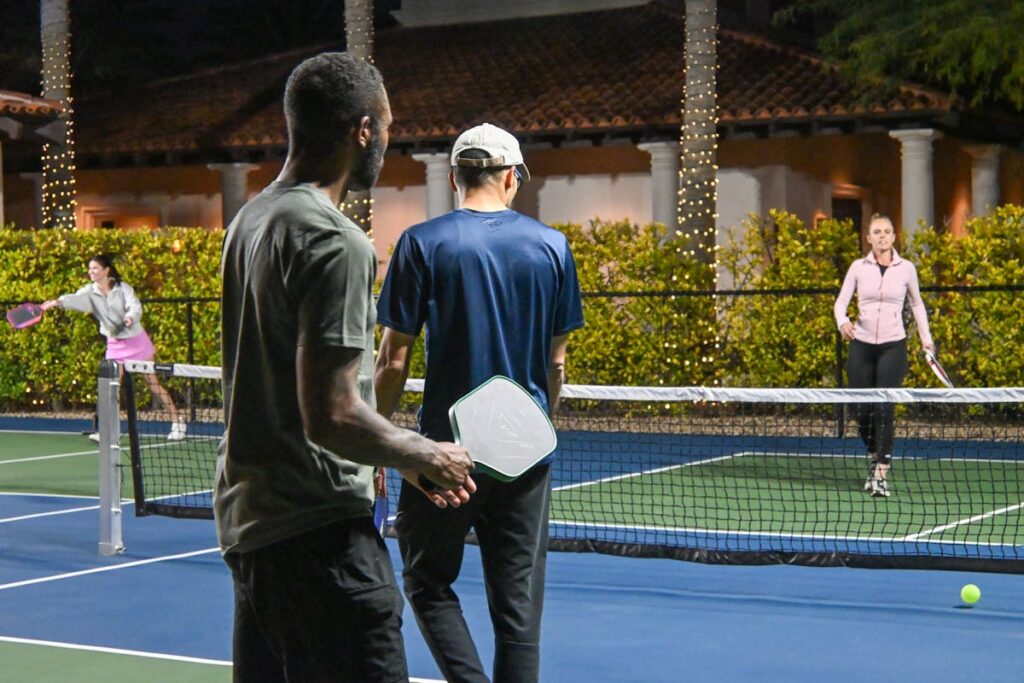
Chances are, you opened this while scrolling. No judgment — I do the same. But something interesting is happening in parks and community centers across the US, and it actually might get you off your phone for good.
I tried pickleball last year expecting nothing. Figured it was for retirement communities and people who couldn’t keep up with tennis anymore. Forty minutes in, I was completely out of breath and already asking when the next session was.
Over 22.7 million Americans now play it — that’s a 223% increase since 2020. These aren’t all retired people with nothing else to do. These are teachers, nurses, parents, and college students. The sport spread this fast for a reason. Several reasons, actually.
| 22.7 million players in the US by 2025 — up from 4.2 million in 2020 (Sports & Fitness Industry Association) |
Here’s what happens to your body — and your head — when you pick up a paddle.
1. It Does More for Your Heart Than a Treadmill (And It’s Actually Fun)
The American Heart Association says adults need 150 minutes of moderate exercise per week. Most people know this. Most people also don’t do it, because moderate exercise is code for boring exercise.
Here’s the part that surprised me: a 2022 study in the Journal of Aging and Physical Activity found that players—average age 62—spent more than 70% of their play time in the moderate-to-vigorous heart rate zone. Not while sprinting. While playing. While chatting between points. While having fun.
| 70%+ of pickleball play time lands in the cardio zone the AHA actually recommends — Webber, Journal of Aging & Physical Activity, 2022 |
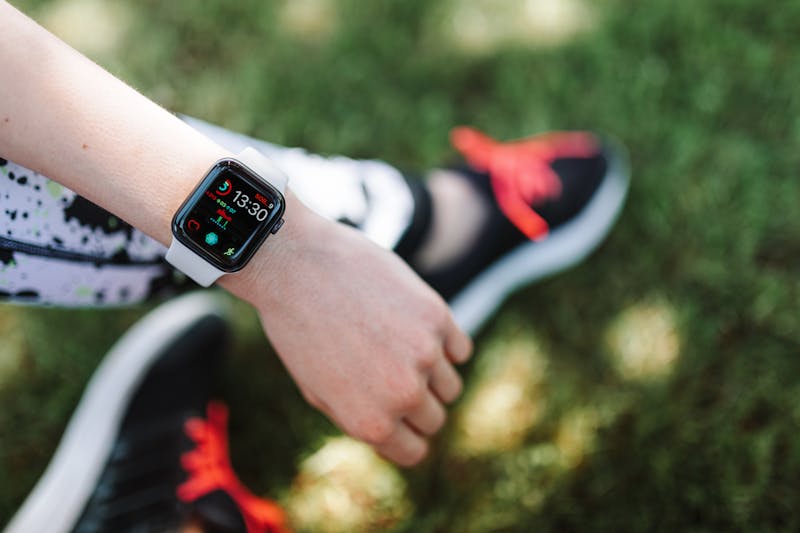
Apple’s Heart and Movement Study analyzed over 250,000 pickleball sessions recorded on Apple Watch. Players averaged peak heart rates within 70% of their max. Sessions ran about 90 minutes. That’s a proper cardiovascular workout by any clinical measure.
Does it replace the gym completely? Probably not — you still want some strength training in the mix. But as a cardio option that people actually stick with, it’s hard to beat.
2. The Calorie Burn Is Genuinely Surprising
This one catches people off guard. Pickleball burns roughly four times more calories per minute than walking. A 30-minute game burns 200 to 300 calories — 36% more than a brisk walk in the same time.
A full 90-minute session? Somewhere between 600 and 900 calories, depending on how competitive things get.
| 4× more calories burned per minute compared to walking (Cleveland Clinic, 2026) |
The mechanism is interval-style movement — short explosive bursts, then brief recovery, then back into it. That pattern mimics HIIT training, which cardiologists have recommended for weight management for years. The difference is nobody is dreading the next interval because they’re too busy thinking about their next shot.
The numbers are strong — though like most fitness studies, they’re based on controlled groups, not real-world chaos. Your mileage will vary based on how hard you play and who you play with. But the direction of the evidence is clear.
3. Your Knees Will Actually Thank You
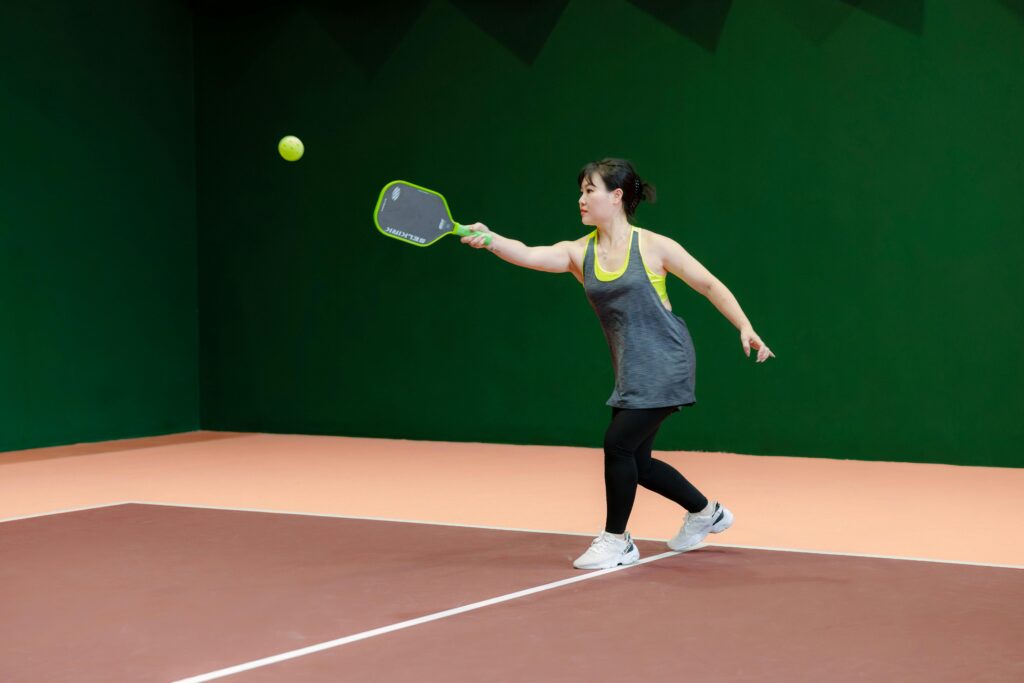
Here’s a quick fact that puts it all in perspective: a pickleball court is 44 by 20 feet. A tennis court is 78 by 36. You cover dramatically less distance per point. The ball moves slower. The serve is underhand, which removes the shoulder strain that sidelines so many tennis players.
Dr. Lisa K. Cannada, an orthopedic trauma surgeon at UNC, notes that pickleball helps maintain bone density and improves balance — both crucial for fall prevention in adults over 50. Physical therapists are increasingly recommending it as a re-entry sport after joint replacements and injury recovery.
For people who have been told to avoid high-impact exercise — or who tried running and paid for it the next morning — this is genuinely good news. You get a real workout without the wear.
4. Something Happens to Your Mood — and It’s Not Just the Endorphins
I wasn’t expecting this part.
After my first few sessions, I noticed I was just… lighter. Less in my head. I figured it was the exercise endorphins — the standard explanation for why any sport improves mood. But talking to regular players, something else kept coming up. It wasn’t the exercise. It was the people.
The game is almost always played in doubles. Four people on a small court, standing close, playing long rallies. Conversations happen naturally. Inside jokes form by week two. People who showed up alone are now meeting for coffee after sessions.
A 2025 systematic review in Frontiers in Psychology pulled together 14 studies and found consistent results: pickleball is meaningfully associated with higher happiness scores, improved life satisfaction, and lower depression. The social integration piece — especially for women — was a significant driver.
| r = 0.263 (p < 0.001) correlation between pickleball participation and happiness — 14-study systematic review, Frontiers in Psychology, 2025 |
The research makes sense when you think about it. Exercise releases endorphins. Social interaction releases oxytocin. Friendly competition builds confidence. Pickleball delivers all three in one session. It’s not magic. It’s just a very efficient delivery system for feeling good.
5. Your Brain Gets a Workout Too — and This One Actually Matters Long-Term
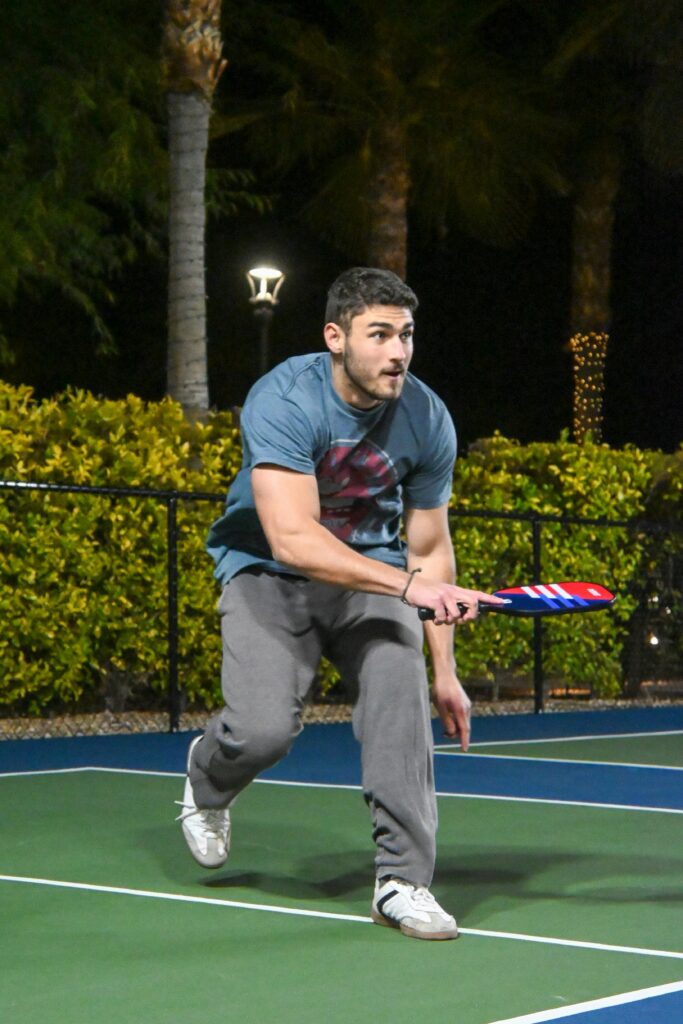
Every single point in pickleball is a micro-decision chain. Where is my opponent? Where is the gap? Cross-court or down the line? Back off or come to the net? This is happening in real time, over and over, for 90 minutes.
Neuroscientists studying activities that combine physical movement with mental challenge have found this combination creates ideal conditions for neuroplasticity — the brain building new connections. Research published in the Journal of Alzheimer’s Disease found that seniors who regularly played racquet sports showed a 47% lower risk of dementia compared to sedentary peers.
| 47% lower risk of dementia in seniors who regularly played racquet sports vs sedentary peers — Journal of Alzheimer’s Disease research cited across multiple 2025 reviews |
Penn State sports medicine physician Dr. Mike Zehner has pointed to the link between activities like pickleball and reduced risk of early-onset dementia and Alzheimer’s. The social component adds another cognitive layer — conversation and strategic banter during play stimulate language processing and emotional regulation.
Younger players notice this too — better focus at work, faster reaction times, sharper memory. It’s not a guaranteed outcome. But the direction of the research is consistent enough to take seriously.
6. It Fixes Something That No Fitness App Can
In 2023, the US Surgeon General formally declared loneliness a public health epidemic. One in four Americans over 50 reports feeling socially isolated. And the downstream health effects are serious — loneliness raises the risk of heart disease by 29%, stroke by 32%, and dementia by 50%.
A 2025 national survey published in PMC specifically studied the relationship between pickleball and loneliness. Adults over 50 who currently played pickleball reported significantly lower perceived loneliness and social isolation than those who had never played. The study was careful to note that more research is needed — but the signal is strong enough to be meaningful.
| 29% higher heart disease risk associated with social isolation and loneliness among older adults (US Surgeon General, 2023) — and pickleball directly attacks this |
Moffitt Cancer Center ran a pilot program in 2025 called Project Rally — a community pickleball program for cancer survivors. The results showed strong improvements in both physical and social well-being. The lead researcher described pickleball as a tool for building connections in a way that clinical settings rarely manage.
This isn’t a soft benefit you can ignore. Social connection is a cardiovascular intervention. And pickleball delivers it in a way that no fitness app or online community has figured out.
7. The Barrier to Entry Is Almost Zero
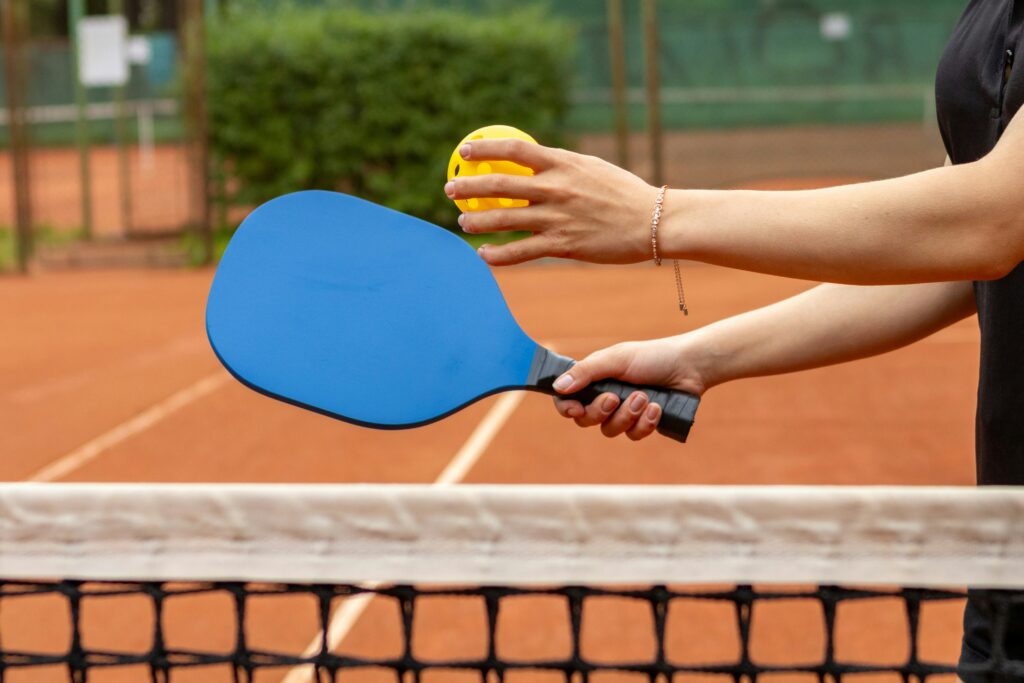
Most sports punish beginners. Pickleball doesn’t. The rules fit on one page. The court is small enough that new players can rally within their first 20 minutes. A starter paddle and ball set costs under 30 dollars — less than a single CrossFit drop-in fee.
The US now has over 70,641 pickleball courts across 16,210 locations, with 536 new ones built in 2024 alone. Most community centers and public parks have free outdoor courts. Search ‘pickleball courts near me’ and you will almost certainly find something within a few miles.
| 70,641+ courts across the US — most in public parks and recreation centers, free to use (SFIA, 2025) |
A 2024 review of 27 studies confirmed that the accessibility of the sport — the low cost, the short learning curve, the welcoming community — is a major reason why people actually stick with it long-term. And that consistency is the engine behind every benefit on this list.
It’s not perfect for everyone. Some people find it too slow. Others develop overuse injuries if they ramp up too fast. And if you’ve had serious joint issues, it’s worth checking with your doctor first. But as entry points into regular physical activity go, it’s about as low-friction as they come.
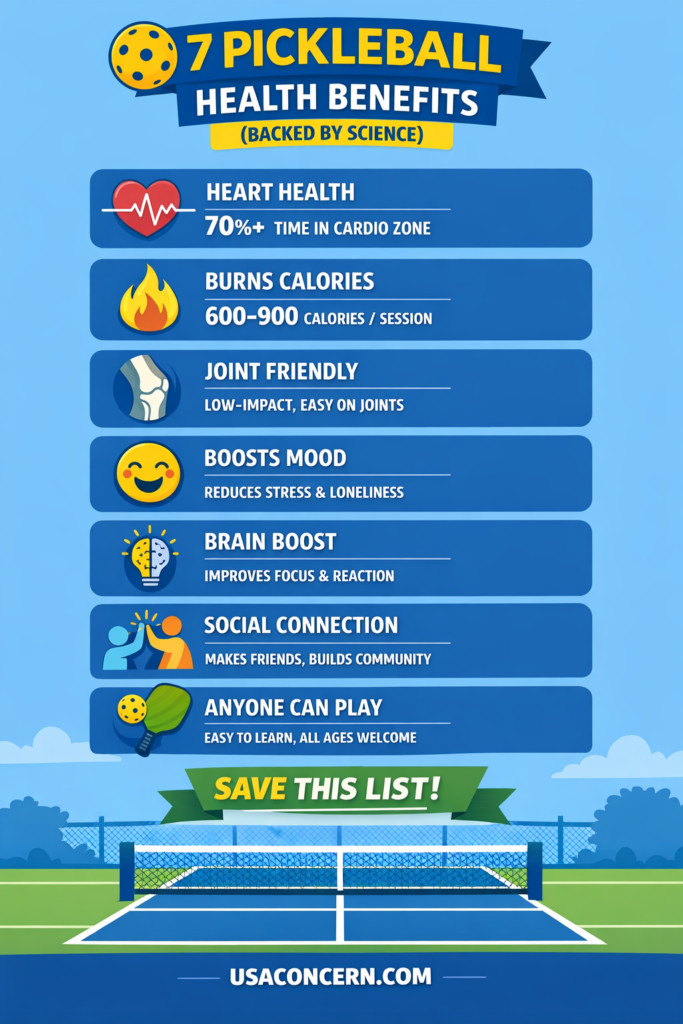
All 7 Benefits at a Glance
| # | Benefit | Quick stat |
| #1 | Heart health | 70%+ play time in cardio zone |
| #2 | Burns calories | Up to 4× more than walking |
| #3 | Joint-friendly | ¼ the court size of tennis |
| #4 | Mood & happiness | r = 0.263 correlation with happiness |
| #5 | Sharper brain | 47% lower dementia risk vs sedentary |
| #6 | Real friendships | Lowers loneliness — a clinical risk factor |
| #7 | Easy to start | Under $30, 70,641+ courts in the US |
Honestly, Just Try It Once
I went in skeptical. I left hooked. That seems to be the standard story.
The research behind why pickleball works is genuinely solid — heart health, cognitive protection, mood, weight management, joint safety. These are not marketing claims. They come from Cleveland Clinic, Mayo Clinic, Harvard researchers, Apple’s health study, and peer-reviewed journals.
But the reason people actually keep playing isn’t in any study. It’s that it’s fun in a way that sneaks up on you. You are too busy trying to figure out your next shot to realize you’ve been moving for 90 minutes.
Worst case, you waste an hour. Best case, you find something you actually enjoy — and your body quietly gets healthier in the process.
| Ready to try it? Search ‘pickleball courts near me’ — most are free. Grab a $25 paddle from Amazon. Show up once. Have you played pickleball? Tell me in the comments — I want to hear what your first session was like. |
Thank you for visiting usaconcern.com and taking the time to read our content. Your visit truly matters to us. Stay alert and stay informed, because an informed voice can help shape a better future.
Feel free to leave a comment below with your thoughts!!


Hey, I’m Vishal Srivastava — the person behind USAConcern.com. I started this site because I genuinely believe there are conversations happening in America that deserve more honest, human coverage. I write about health, mental wellness, lifestyle, and the cultural shifts shaping everyday American life, as I come from a strong background in artificial intelligence and engineering, combined with certified knowledge in mental wellness and fitness. My goal is to bridge the gap between technology and human well-being. I believe true success comes from a balance of a sharp mind, a healthy body, and smart use of technology. Through my work, I aim to provide practical solutions that improve both performance and lifestyle. Thanks for reading—your journey to a better mind, body, and life starts here.