
Everyone is talking about the trajectory.
The orbital burns.
The timing. The precision. The science.
But almost no one is talking about how it feels.
What it feels like to wait 54 years for this moment.
What it means to see the first Black man step into deep space.
The first woman travel beyond Earth’s orbit.
What it feels like for a grandfather in Florida, standing outside in the dark,
watching a small streak of light cross the sky…
and realizing he never thought he would live long enough to see this day.
This isn’t just a mission.
This isn’t just numbers and engineering.
This is history.
This is emotion.
This is something deeply human.
Because sometimes, the most important part of space exploration
is not how far we go—
but how it makes us feel when we look up.
At 6:24 PM Eastern Time today—April 1, 2026—four human beings climbed into a capsule on top of a rocket and left Earth. They are heading around the Moon. They won’t land on it. They’ll slingshot around its far side, travel roughly 685,000 miles in 10 days, and come home.
That’s the mission on paper. And I’ve already watched a hundred articles explain exactly that—the trajectory, the burn sequence, the proximity operations, and the free-return path back to a Pacific Ocean splashdown off San Diego.
Nobody is writing what I actually need to read. Not a single person is writing about what it does to you — emotionally, historically, personally — to watch four human beings break through the atmosphere today. In a year of a hiring recession, a wealth gap that keeps widening, grocery bills that won’t quit climbing, and a general feeling that the big systems are not working for regular people, four people just went to the Moon. And I refuse to scroll past what that means.
54 years since any human traveled beyond Earth orbit—Apollo 17, December 1972
685K miles total journey—potentially the farthest humans have ever traveled from Earth
3 historic firsts in a single crew—first Black man, first woman, first non-American in deep space.
The 54-year silence
Let’s start with the number that doesn’t quite register until you hold it still for a moment: 54 years. That is how long it has been since a human being traveled beyond low Earth orbit. Apollo 17 lifted off in December 1972. The astronauts drove a rover across the lunar surface, collected rock samples, planted a flag, and came home. Then humanity collectively decided it was done with that sort of thing.
Think about what 54 years contains. The personal computer was invented. The internet reshaped civilization. The Berlin Wall fell. A pandemic killed millions and rewired how the world works. Whole generations were born, grew up, built lives, had children of their own — and not a single one of them lived in a world where humans were doing anything more than orbiting a few hundred miles overhead. The Moon, which humans had walked on, became again a thing we simply looked at.
This is not a small fact. It means that everyone alive today under the age of 55 has spent their entire conscious life in a world where humanity’s physical reach stopped at low orbit. We built the International Space Station, yes — but the ISS sits roughly 250 miles above Earth’s surface.
The Moon is nearly a quarter of a million miles away. We were not, in any meaningful sense, explorers. We were tenants of a very thin shell above our own planet.
Today that changed. Not forever — nothing is guaranteed — but for this moment, and almost certainly for more moments to come, it changed.
A spacecraft, a cracked heat shield, and a decision nobody envied
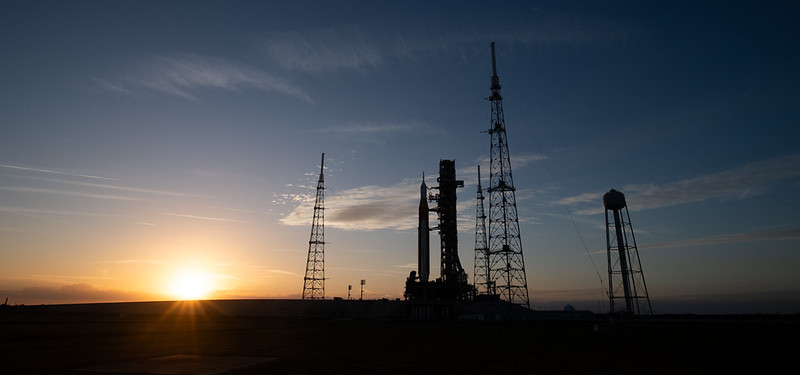
The first thing to understand about Artemis II is that it should not exist in the form it does. Not because the mission is wrong, but because the path to this launch was an unrelenting series of near-failures that were quietly resolved without the public ever fully knowing how close things came to unraveling.
It begins with the heat shield. When the uncrewed Artemis I mission returned to Earth in December 2022, engineers expected the Orion capsule’s heat shield to show standard wear. What they found instead was alarming: over a hundred locations where chunks of the ablative material — a substance called Avcoat, the same basic approach used in the Apollo era — had broken off unpredictably during reentry.
The shield had cracked and shed material in patterns that their pre-flight models had not predicted. The temperatures inside the capsule had remained safe, but that was partly luck, partly the specifics of that particular trajectory. With four human lives on the next mission, the margin for luck felt uncomfortably thin.
What is Avcoat? It’s an ablative material — meaning it’s designed to slowly burn away as the spacecraft reenters the atmosphere, carrying heat away from the capsule in the process. The problem discovered after Artemis I was that gases trapped inside the material weren’t venting properly during a specific reentry maneuver, causing internal pressure to build until the material cracked and shed in irregular chunks — harder to predict, harder to account for.

NASA spent the better part of two years investigating this. The investigation was thorough — over a hundred separate tests, facilities across multiple states, independent review panels, engineers in disagreement with other engineers.
The central debate was whether to replace the Artemis II heat shield entirely (a move that would have pushed the launch to late 2026 or early 2027 at minimum) or to fly with the existing shield but modify the reentry trajectory to reduce the thermal stress. They chose the latter. They also eliminated the “skip reentry” maneuver — the technique where Orion dips briefly into the atmosphere, bounces back out, then comes in again — because that was precisely the maneuver that had caused the gas buildup in the first place.
Not everyone agreed with this decision. Some engineers and outside experts continued to object right up until launch, arguing that flying with a known-imperfect heat shield was taking on unnecessary risk. NASA’s response, essentially, was that the risk had been characterized, mitigated, and was within acceptable bounds — and that replacing the shield would introduce a different set of risks, including schedule pressure compounding on future missions.
“Sometimes in space, delays are agonizing. Slowing down is agonizing, and it’s not what we like to do — but the investigation was important for the future of NASA’s moon missions.” — Artemis II commander Reid Wiseman
This is the kind of decision that rarely makes the news because it doesn’t resolve cleanly. There was no villain, no vindication, no obvious right answer. Just people trying to make the best call with imperfect information, in full knowledge that they were betting four human lives on their reasoning. That is, I think, what makes it worth understanding.
The money — and the politics behind it
The technical story of Artemis is difficult enough. The political story is almost harder to follow, and in some ways more revealing about the world we live in.
Artemis has always been expensive. The SLS rocket — the most powerful to ever reach orbit — costs roughly $2 billion per launch. The Orion capsule development has run for nearly two decades and cost tens of billions. The total Artemis program expenditure since its inception has been estimated at well over $90 billion when all components are included.

What happened in the years leading up to today’s launch was a quiet war over whether the program would survive at all. In early 2025, the Trump administration’s proposed budget for NASA was a shock to the space community a 24% cut to the overall agency, the science budget slashed nearly in half, and perhaps most significantly, a proposal to end the SLS and Orion programs after Artemis III — the planned Moon landing in 2027 — and hand future lunar missions entirely to commercial providers like SpaceX and Blue Origin.
The Planetary Society called it, without apparent exaggeration, an “extinction-level event” for NASA science.
Congress did not simply accept this. Senator Ted Cruz of Texas, who chairs the Senate Commerce Committee and represents a state with enormous NASA infrastructure, introduced an amendment to what the administration called the “One Big Beautiful Bill” — a wide-ranging reconciliation measure — that injected nearly $10 billion in additional NASA funding. The amendment preserved the Gateway lunar outpost, funded SLS production for Artemis IV and V, and effectively kept the program alive beyond the three missions the executive branch had proposed. The bill was signed into law on July 4, 2025.
The result was a strange kind of compromise a White House that publicly doubted the program’s cost-effectiveness, a Congress that quietly rescued it, and a NASA that had to plan its future in the shadow of institutional uncertainty. Artemis II launched today not because there was political consensus that it should exist, but because enough people in enough rooms fought hard enough to keep it going.
The budget in brief: The proposed FY2026 NASA budget would have been the smallest in real terms since 1961. Congress rejected the deepest cuts. The reconciliation bill added $4.1 billion for SLS production, $2.6 billion for Gateway, and $1.25 billion for ISS operations — preserving the program’s future, at least through the end of the decade.
Who is on this mission — and why it matters more than a footnote
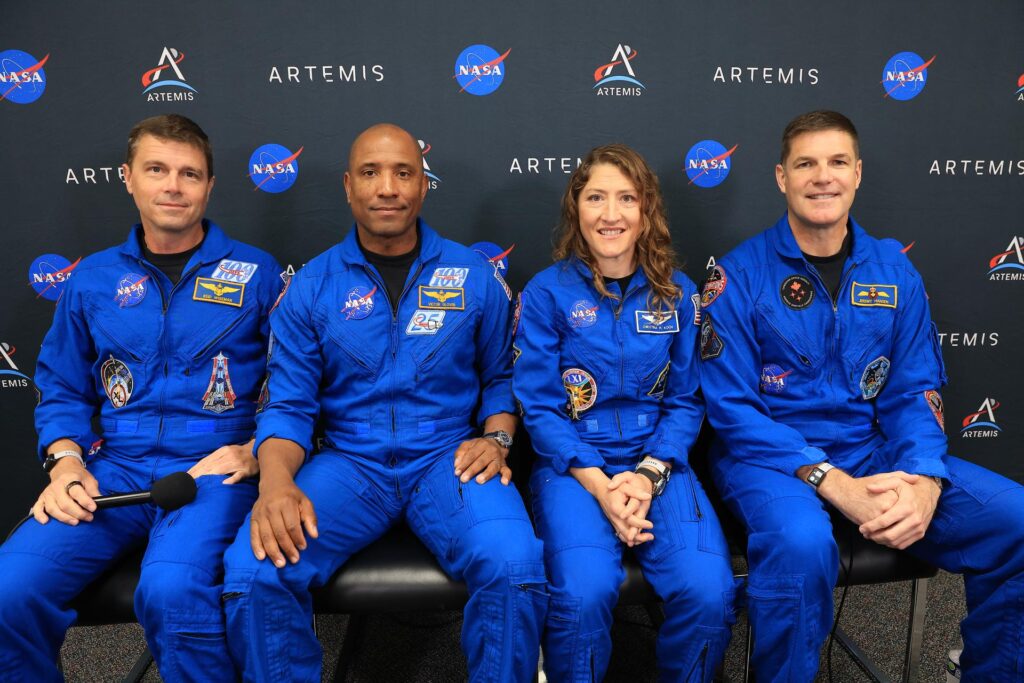
The crew of Artemis II has been introduced so many times in so many articles that there’s a risk of the historic nature of their composition becoming wallpaper. Let me try to say it differently.
For over fifty years, the image of a human being who travels beyond Earth’s orbit has been white, American, and male. Not because the laws of physics required this. Not because this was anyone’s deliberate long-term plan. But because of the specific historical moment in which the Apollo program was created and the specific people that moment included and excluded. That image calcified. It became the default mental picture of what a deep space explorer looks like.
Today that image broke. Victor Glover is the first person of color to travel beyond low Earth orbit. Christina Koch is the first woman. Jeremy Hansen, representing the Canadian Space Agency, is the first person who is not American to approach the Moon. These are not symbolic gestures. They are facts — facts that will now exist permanently in the record of what humans have done. A child who grows up from this day forward will never live in a world where only one kind of person has gone to the Moon.
That matters in ways that are genuinely hard to quantify but very easy to underestimate. Representation in exploration is not about optics. It is about who, looking at the stars, is able to imagine themselves out there — and therefore who chooses to study, to work, to push. The pipeline of future astronauts, engineers, and scientists is not built from abstract inspiration. It is built from the specific, concrete sight of people who look like you doing things you did not know were available to you.
What this moment means for the children alive today
There is a generation of children right now — the ones born in the last five to ten years — who will grow up with something that no living generation before them has had since the early 1970s: the normalcy of humans going to the Moon. If the Artemis program proceeds as planned, there will be a crewed lunar landing in 2027 or 2028. There will be a lunar outpost. There will, if current timelines and funding hold, be a Mars mission in their adult lifetimes.
I don’t think we fully appreciate what it does to a young mind to grow up in a world where humans are actively, regularly going somewhere. The Apollo generation grew up knowing this was possible. Then it stopped. The generation that followed — my generation and the ones around it — grew up being told that humans had once done this extraordinary thing and that we would do it again someday, eventually, when the funding came through, when the politics aligned, when the technology was ready. “Someday” is a devastating word to grow up with. It is a promise that requires no commitment.
Today is not “someday.” Today is a launch date, a trajectory, a crew. And the children who watched it, or whose parents told them about it, or who will read about it in school in ten years — they will grow up knowing that humans go to the Moon. Not went. Go.
The harder question underneath all of this
I want to sit with something uncomfortable for a moment, because I think intellectual honesty requires it. Artemis costs a great deal of money. The SLS rocket, whatever its engineering achievements, is widely criticized within the aerospace community as a vehicle that costs too much per launch to be sustainable. The budget battles that nearly killed the program were not purely political theater — some of the underlying concerns about cost and long-term viability are real and legitimate.
At the same time, the argument that exploration should wait until it becomes economically convenient is, I think, a misunderstanding of what exploration is. It is, almost by definition, a costly, risky, frequently inefficient endeavor undertaken for reasons that only become fully clear in retrospect. The Apollo program’s return on investment cannot be calculated in dollars. Its return was a generation of engineers, a transformed sense of what technology could do, a geopolitical signal, and — perhaps most durably — the photograph of Earth from space that changed how people thought about their own planet. You do not know in advance what you will learn by going somewhere you have never been.
What I keep coming back to is this: civilizations that stop reaching outward do not simply stay where they are. They calcify. The habit of ambition — of doing something difficult because it stretches the boundaries of what humans are capable of — is a habit that atrophies without use. Artemis II is, among many other things, a civilization keeping that habit alive.
The question was never really whether we could afford to go. It was whether we still had the kind of seriousness required to try.
Where they are right now
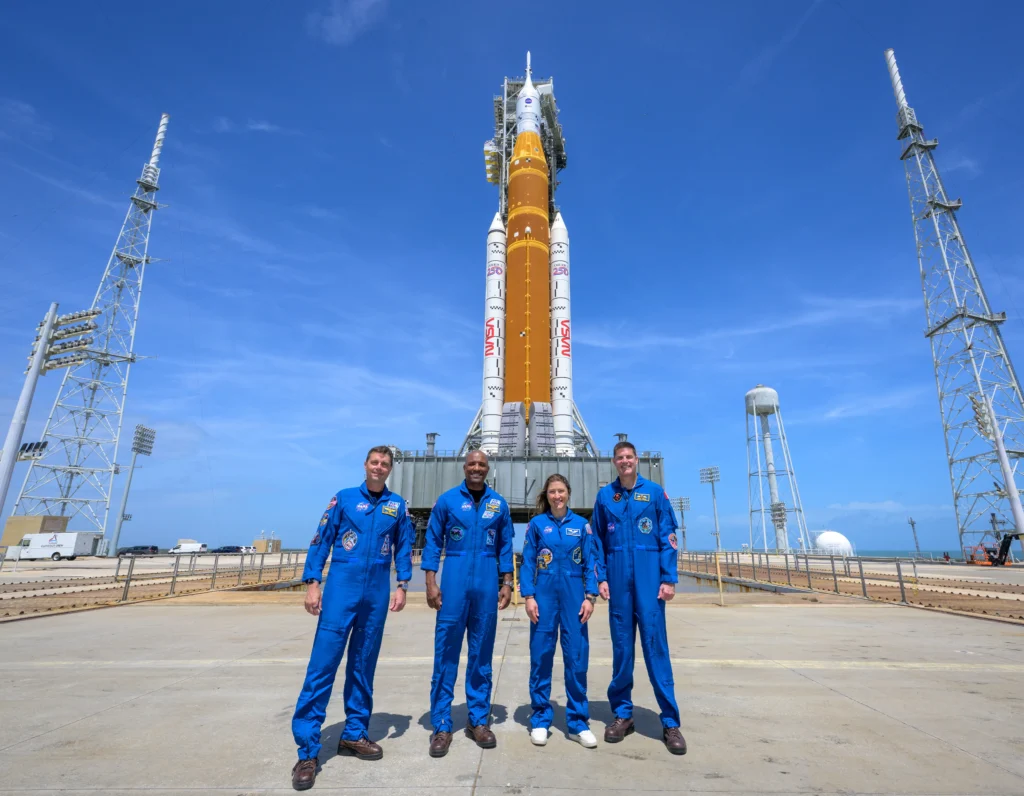
As of this writing, the crew is moving away from Earth at a speed and distance that are difficult to picture. In a few days, they will pass the distance record currently held by Apollo 13 — set not during a triumphant mission, but during an emergency, as the crew fought to survive a catastrophic failure and get home. Artemis II will break that record on purpose, as an act of exploration. That alone feels like something worth noting.
They will lose contact with Earth briefly as they pass behind the Moon’s far side. For a few minutes, they will be more alone than any humans have been since 1972 — cut off from every signal, every voice, every human institution. Just four people and a spacecraft and the Moon.
Then they will come around the other side, re-establish contact, and begin the journey home. In ten days, give or take, they will splash down in the Pacific off San Diego. There will be boats and helicopters and cameras. There will be press conferences. Things will return, fairly quickly, to normal.
But something will be different. The 54-year silence will be over. The question of whether we still do this sort of thing will have been answered. And somewhere, a child who watched a rocket leave the ground today will spend the next several years thinking about what they want to build, where they want to go, what they think is possible.
That is, when you trace it out, what this mission is actually for.
This post was written on April 1, 2026 — the day of the Artemis II launch. All figures and political details are sourced from NASA, the Planetary Society, NASASpaceflight.com, and congressional budget records.
Thank you for visiting usaconcern.com and taking the time to read our content. Your visit truly matters to us. Stay alert and stay informed, because an informed voice can help shape a better future.
Feel free to leave a comment below with your thoughts!!


“Hey, I’m Vishal Srivastava — the person behind USAConcern.com. I started this site because I genuinely believe there are conversations happening in America that deserve more honest, human coverage. I write about health, mental wellness, lifestyle, and the cultural shifts shaping everyday American life. No corporate agenda. No fluff. Just real stories, real research, and my honest take on what it all means. Thanks for reading — it means more than you know.”