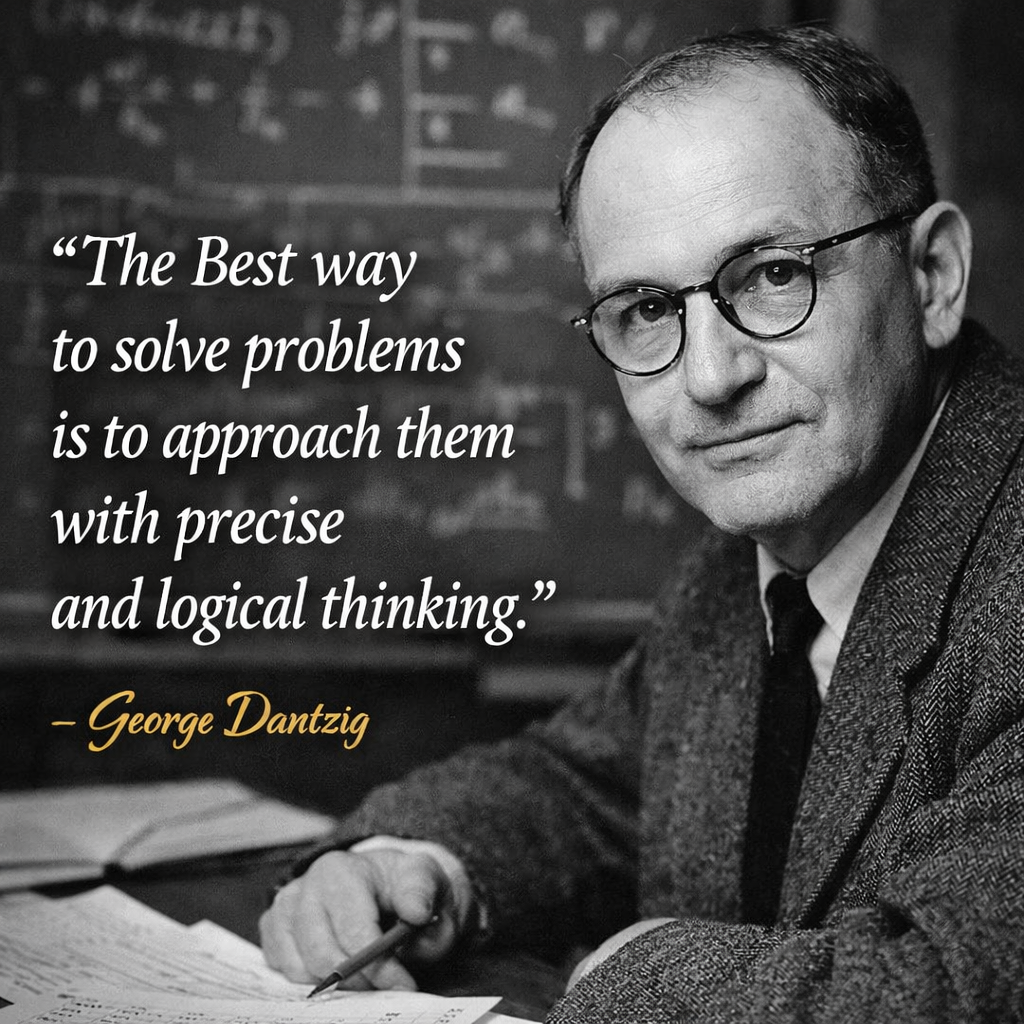
In the world of mathematics and economics, few names carry as much quiet power as George Dantzig. While the average American may not instantly recognize his name, his work shapes everyday life—from airline scheduling and military logistics to supply chains, business strategy, and even modern artificial intelligence. If you’ve ever wondered how companies optimize routes, reduce costs, or maximize profits using data, you’re already living in Dantzig’s world. This is the remarkable story of the man who invented linear programming and forever changed decision-making in America and beyond. Who Was George Dantzig? Born on November 8, 1914, in Portland, Oregon, George Bernard Dantzig grew up in a household deeply connected to mathematics. His father, Tobias Dantzig, was a mathematician and author, which meant young George was exposed early to the beauty and structure of numbers. Dantzig pursued mathematics at the University of Maryland and later completed his Ph.D. at the University of California, Berkeley. But before he became a professor and academic legend, he stumbled into one of the most famous stories in mathematical history. The Homework That Wasn’t Homework While studying at Berkeley in 1939, Dantzig arrived late to a statistics class taught by Jerzy Neyman. On the blackboard, he saw two problems written down. Assuming they were homework, he copied them and solved them over the next few days. What Dantzig didn’t realize was that the problems were actually unsolved statistical challenges—considered nearly impossible at the time. When he turned in his “homework,” Neyman was stunned. Dantzig had unknowingly solved two open problems in statistics. That moment became one of the most inspiring stories in academic history, often used to illustrate the power of mindset and belief. The Birth of Linear Programming During World War II, Dantzig worked for the U.S. Air Force as a civilian mathematician. The military needed better methods to allocate limited resources efficiently—fuel, personnel, aircraft, supplies. Out of this need, Dantzig developed what is now known as linear programming—a mathematical technique for optimizing outcomes under constraints. His breakthrough algorithm, the Simplex Method, provided a systematic way to solve large-scale optimization problems. Before Dantzig, such problems were too complex to solve practically. After Dantzig, industries had a powerful decision-making tool.
Today, linear programming is used in: Airline scheduling Supply chain management Financial portfolio optimization Manufacturing production planning Energy distribution systems Telecommunications networks In short, modern America runs on systems powered by Dantzig’s ideas.
The Simplex Method: A Game-Changer The Simplex Method remains one of the most important algorithms in computational mathematics. Despite being developed in the 1940s, it is still widely used today. It works by navigating the corners of a feasible region defined by linear inequalities to find the optimal solution. While that may sound technical, its impact is simple: maximize efficiency, minimize waste. From Amazon warehouses to airline route planning, businesses rely on optimization models rooted in Dantzig’s work. Without George Dantzig, the efficiency of modern logistics—especially in a post-pandemic, inflation-sensitive American economy—would look very different. George Dantzig and the Rise of Operations Research Dantzig’s work helped establish the field of operations research as a respected scientific discipline. Operations research blends mathematics, statistics, and computer science to improve decision-making. He later became a professor at Stanford University, where he continued refining optimization theory and mentoring generations of mathematicians. The story became legendary, inspiring a scene in the movie Good Will Hunting.

At Stanford, Dantzig built one of the world’s leading centers for optimization research, influencing industries, governments, and academia globally. Why George Dantzig Matters More Than Ever in 2026 As America navigates economic uncertainty, AI transformation, and global supply chain disruptions, optimization is no longer optional—it’s essential. Artificial intelligence systems, machine learning models, and advanced analytics all rely on optimization techniques that trace back to Dantzig’s foundational work. When tech giants use algorithms to recommend products, manage warehouses, or optimize delivery routes, they are applying mathematical principles Dantzig pioneered nearly 80 years ago. In the age of big data, Dantzig’s legacy is not fading—it is expanding. Awards and Recognition Throughout his career, George Dantzig received numerous honors, including: The National Medal of Science (awarded by the U.S. government) The John von Neumann Theory Prize Membership in the National Academy of Sciences Though he passed away in 2005, his influence continues in every optimization model run across the globe.
The Human Side of a Mathematical Giant Despite his extraordinary achievements, Dantzig was known for humility. He often credited collaboration and real-world problem-solving for driving his work. The story of solving “impossible” problems by accident became symbolic of his approach: focus on the task, not the fear. It’s a lesson that resonates deeply in today’s competitive academic and business environments. Sometimes, limitations are psychological rather than mathematical. George Dantzig’s Lasting Legacy in America From Wall Street to Silicon Valley, from government defense departments to retail giants, Dantzig’s influence is everywhere. In a nation driven by efficiency, innovation, and competition, George Dantzig quietly built the mathematical backbone of modern optimization. He may not be a household name like Einstein, but in the world of applied mathematics and economics, his impact is just as transformative. Every time a company reduces costs, every time a delivery arrives faster, and every time a data-driven decision saves millions—George Dantzig’s legacy is at work. Final Thoughts The story of George Dantzig is more than a biography—it’s a reminder that innovation often begins with curiosity and persistence. From accidentally solving unsolved problems to inventing linear programming, Dantzig proved that mathematics isn’t just abstract theory. It’s a practical tool that powers modern society. For readers of USAConcern.com, his life offers a powerful takeaway: behind every efficient system lies brilliant thinking. And behind much of America’s optimization revolution stands one remarkable mathematician—George Dantzig.
Conclusion: A Genius Who Changed the World Without Even Knowing It George Dantzig’s story is more than just a famous classroom mistake — it’s a powerful reminder of what human potential truly looks like. What began as two unsolved problems scribbled on a blackboard turned into a breakthrough that reshaped mathematics, economics, military logistics, business strategy, and modern computing. His development of linear programming and the simplex algorithm didn’t just solve equations — it solved real-world problems. From optimizing airline routes and supply chains to shaping government planning and business decision-making, Dantzig’s work quietly powers the modern world. But perhaps the most inspiring part of his legacy is this: he solved those “impossible” problems simply because he didn’t know they were supposed to be impossible. In a world where limits are often self-imposed, George Dantzig’s life teaches us a timeless lesson — sometimes the only difference between ordinary and extraordinary is the belief that something can be done. He wasn’t just a genius by accident. He was proof that opportunity favors the prepared mind — and the fearless one.
Thank you for visiting usaconcern.com and taking the time to read our content. Your visit truly matters to us. Stay alert and stay informed, because an informed voice can help shape a better future.
Feel free to leave a comment below with your thoughts!!