
“Hello friends. I was just wondering why there hasn’t been any reaction from America yet. As you all know, America—and especially Trump—will certainly not be happy about the trade deal between India and the European Union. Finally, just a few hours before the deal’s announcement, it is being said: ‘Europe is funding a war against itself with the India-European Union trade deal.’ This was stated by their own Finance Minister, who is referred to as the Treasury Secretary. We will understand in detail what America’s problem is, and I will show you the clear-cut hypocrisy.
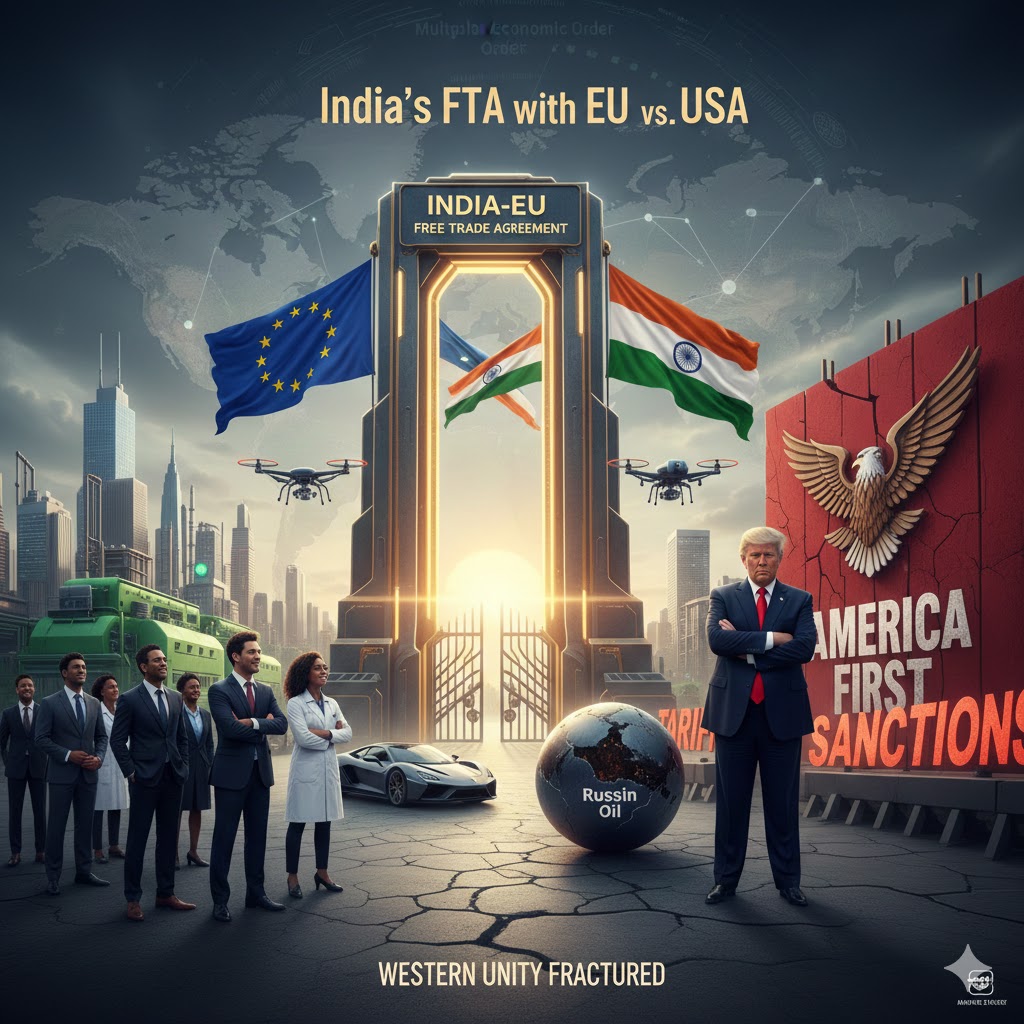
Why Is It Called the “Mother of All Trade Deals”?
First, let’s explore why this is being termed the “Mother of All Trade Deals.” You may have recently heard this phrase used by Ursula von der Leyen, the President of the European Commission. The scale of this deal is unprecedented; it connects India—the world’s fastest-growing major economy—with the world’s richest single market.
In terms of sheer scale, this involves 27 European Union nations and India, encompassing 2 billion people and 25% of global GDP. In human history, this is the largest deal to date, surpassing even NAFTA and the EU-Japan FTA.
What’s Included in the Deal?
Essentially, it covers everything:
- Goods: The EU will reduce tariffs on Indian textiles, leather, gems, jewelry, chemicals, and engineering goods. Conversely, India will lower duties on high-end machinery, wine, spirits, and automobiles. For example, the 110% tariff on luxury cars will be slashed to 40%.
- Services: India is pushing for easier visa access for IT professionals and the recognition of Indian qualifications in Europe. Meanwhile, the EU seeks entry into India’s banking, insurance, and digital services sectors.
- Investment & Supply Chains: European companies are expected to shift their manufacturing bases from China to India, making India a “China Plus One” destination and a global manufacturing hub.
Why is America Unhappy?
Now, the question arises: why is America disgruntled? As the saying goes, America is playing the role of the “displeased uncle” at a wedding. This is where oil, war, and hypocrisy intersect.
The Russian Oil Triangle: Since Russia began selling discounted crude oil, India participated significantly because we needed affordable energy. This is entirely legal; there are no UN sanctions, only unilateral US sanctions. This trade saved India billions of dollars. Indian refiners, particularly Reliance, converted this Russian crude into diesel, petrol, and jet fuel, which was then purchased in massive quantities by the European Union.
The US Argument: The US Treasury Secretary, Scott Bessent, argues that by buying refined oil from India, Europe is indirectly sending money to Russia, which in turn funds the threat against Europe. He explicitly stated that “Europe is financing a war against itself” through this India-EU trade deal. This has created a rare and visible friction between the US and its European allies.
The Height of Hypocrisy (Double Standards)
The US claims it has made the biggest sacrifices to stop the Russia-Ukraine war, but its stance reeks of double standards. While lecturing Europe, the US itself continues to purchase Russian uranium and nuclear fuel. If the US wants others to stop, it should first stop its own selective trade with Russia. This inconsistency proves their lectures are based on political maneuvering rather than moral authority.
The Real Reasons for US Opposition
America isn’t just worried about Russia; they are worried about losing Economic Leverage:
- Losing the Pressure Game: Trump’s strategy was to use tariffs to pressure India, but the India-EU deal weakens that coercion.
- Fractured Unity: The US wants its allies to follow its sanction regime blindly. By choosing national interest over “bloc loyalty,” Europe and India are demonstrating a move toward a multipolar world.
- Capital Competition: Trump wants manufacturing to return to the US, but this deal encourages European capital to flow into India instead.
India’s Strategic Autonomy
India has maintained its strategic autonomy. We haven’t violated international law, and we have refused to succumb to unilateral US pressure. For India, energy security is more important than political pressure. We are multi-aligned: buying oil from Russia, trading with the EU, and still negotiating with the US.
European Calculation
Why is the EU risking US anger? They see China as unstable and the US as increasingly protectionist. They view India as a stable democracy, a massive market, and a long-term strategic hedge.
The Global Big Picture
This deal signals a decline in US economic dominance. We are seeing:
- The rise of regional mega-deals.
- Energy reshaping global politics.
- The fading power of absolute US sanctions.
- A new order where Trade is bigger than Ideology, Energy is bigger than Morality, and National Interest is bigger than Alliances.
- In 2026, the divergence between the American “transactional” model and the European “strategic integration” model has reached a critical point. While Washington focuses on reducing trade deficits and enforcing burden-sharing, Brussels is prioritizing a long-term economic hedge against both China and U.S. protectionism.
- Comparison of US and EU Trade Approaches Toward India (2026)
| Feature | United States (Trump Administration) | European Union (Expedition 72 Era) |
| Core Philosophy | “America First” / Transactional: Focuses on immediate trade balance and reciprocity. | Strategic Autonomy: Focuses on long-term supply chain de-risking from China. |
| Key Mechanism | Tariff-Based Coercion: Uses high import duties (e.g., 25% extra) to force concessions. | Comprehensive FTA: Pursues “The Mother of All Trade Deals” to integrate markets. |
| Energy Stance | Sanction Enforcement: Pressures India to stop purchasing and refining Russian crude oil. | Pragmatic Consumption: Indirectly imports refined Russian fuel via Indian refiners. |
| Manufacturing | Reshoring: Incentivizes companies to move production back to U.S. soil. | China Plus One: Actively shifts European manufacturing bases to India. |
| Services & Labor | Restrictive: Tightens H-1B and professional visas to protect domestic labor. | Collaborative: Negotiating easier visa access for Indian IT and talent pools. |
| Strategic View | Security Partner: Views India primarily as a military check against China. | Economic Anchor: Views India as a stable, democratic alternative to the U.S. market. |
| Primary Friction | India’s “Russian Oil Triangle” and trade surplus with the U.S. | Regulatory alignment on digital services and sustainability standards. |
- Establishing these distinctions helps clarify why India is currently navigating a “multi-aligned” strategy to balance both powers.
Here’s a compelling 10-post Twitter thread exposing US hypocrisy regarding Russian oil and the India-EU trade deal, perfect for sparking debate and maximizing engagement.
1/10 🌍 The “Mother of All Trade Deals” between India & the EU is sending shockwaves, but the US reaction? Pure #Hypocrisy. Washington is furious, calling it “funding war.” Let’s break down the double standards. #IndiaEU #TradeDeal #Geopolitics
2/10 🗣️ US Treasury Secretary Scott Bessent: “Europe is funding a war against itself with the India-EU trade deal.” Strong words, implying Europe is indirectly supporting Russia. But what’s the full picture? 🤔 #RussiaOil #USForeignPolicy
3/10 🇮🇳🤝🇪🇺 The Deal: India buys discounted Russian crude, refines it, then sells finished products (diesel, jet fuel) to the EU. This is LEGAL under international law. No UN sanctions violated. India prioritizes its energy security. #IndiaFirst #EnergySecurity
4/10 💰 India saved billions, and Europe got cheaper fuel. It’s a win-win for them, strategically circumventing high global energy prices. But the US sees it as indirectly funneling money to Moscow. Fair enough, on the surface. #GlobalTrade #EconomicStrategy
5/10 🚨 THE HYPOCRISY UNMASKED: While the US lectures India & Europe, guess who’s still buying Russian uranium and nuclear fuel directly from Russia? The United States itself. Yes, you read that right. #USDoubleStandards #RussiaUkraineWar
6/10 🤯 If Europe buying refined Russian oil from India is “funding war,” then the US directly importing Russian nuclear components is… what exactly? A friendly gesture? The silence from Washington on their own actions is deafening. #SelectiveOutrage #GeopoliticalGames
7/10 🎯 Trump’s Aim: This isn’t just about Russia. It’s about US losing economic leverage. India moving closer to EU weakens Trump’s “tariff-based coercion.” His ‘America First’ means America only, not for its allies. #AmericaFirst #TradeWars
8/10 🌐 This India-EU deal signals a new multipolar world. Countries are prioritizing #NationalInterest over rigid bloc loyalties. Sanctions are losing their absolute power, and trade is increasingly decoupled from ideology. #NewWorldOrder
9/10 💥 The US is angry because its traditional allies (EU) and partners (India) are forging independent paths. This deal shifts manufacturing from China to India, diverting capital from the US, a trend Trump openly opposes. #SupplyChain #EconomicDominance
10/10 📉 Conclusion: The US criticism of the India-EU deal isn’t a moral stand, but a political one. It exposes Washington’s selective application of rules and its struggle to maintain economic dominance in a rapidly changing world. What do you think? 👇 #GlobalPolitics #IndiaEUTrailing
Conclusion.
The conclusion of the current geopolitical standoff is that India has successfully utilized its “strategic autonomy” to secure a historic trade deal with Europe, effectively neutralizing the economic leverage previously held by the United States. While the Trump administration views the India-EU FTA as an indirect subsidy to Russia’s war effort, the agreement represents a broader shift toward a multipolar economic order where national interest and supply chain diversification outweigh traditional bloc loyalties. Ultimately, this deal transforms India into a critical “China Plus One” manufacturing hub for Europe, signaling a significant decline in the absolute power of unilateral U.S. trade sanctions.
Pingback: Why Millions of Americans Are Feeling the Unusual Pressure in 2026 - usaconcern.com